The Gomateshwara statue at Shravanabelagola is one of the most iconic monuments in India and a masterpiece of monolithic sculpture. Standing about 57 feet tall on Vindhyagiri hill, the Gomateshwara statue — depicting the Jain saint Bahubali — is among the tallest free-standing statues in the world and the spiritual heart of Shravanabelagola.
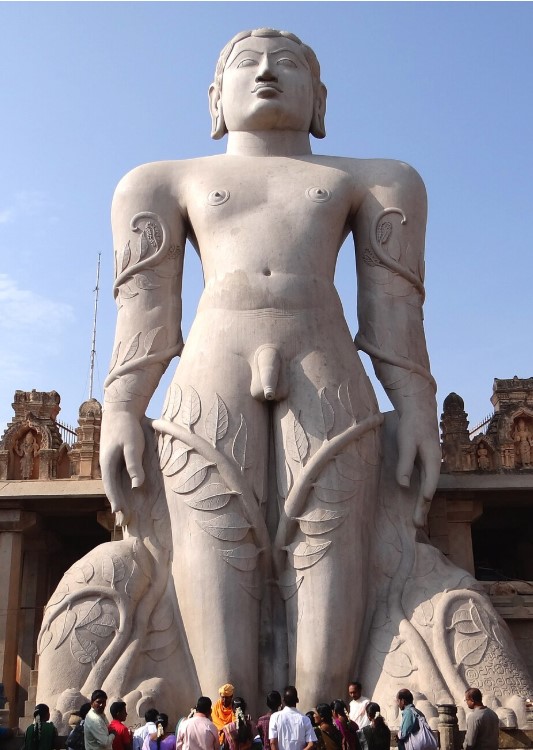
Table of Contents
Who Is Gomateshwara (Bahubali)?
Gomateshwara, more commonly known as Bahubali, was the son of the first Jain Tirthankara, Rishabhanatha (Adinatha). According to Jain tradition, Bahubali defeated his brother Bharata in a contest for their father’s kingdom but, at the moment of victory, was overcome by a sense of the futility of worldly conquest. He renounced everything and stood in deep meditation for a year until he attained kevala jnana (omniscience). The Gomateshwara statue immortalises this moment of supreme renunciation.
Height and Dimensions
The Gomateshwara statue at Shravanabelagola rises to about 57 feet (roughly 17 metres) and is carved from a single block of fine-grained grey granite. Its proportions are remarkable: broad shoulders, a serene face, and a perfectly balanced stance visible from several kilometres away. For centuries it was considered the tallest monolithic statue in the world, and it remains one of the most celebrated examples of the form.
History and Construction
The Gomateshwara statue was commissioned around 981 CE by Chavundaraya (also spelled Chamundaraya), a general and minister of the Western Ganga dynasty. The sculpture was carved in situ from the granite outcrop of Vindhyagiri hill. Numerous inscriptions at the base and around the site record the patronage and later restorations, making the statue not only a religious icon but also a key historical monument of medieval Karnataka.
Symbolism of the Statue
Bahubali is shown in the kayotsarga posture — standing motionless in meditation. Creepers and vines are depicted winding up his legs and arms, and anthills are carved at his feet, signifying how long and how completely he stood absorbed in penance, oblivious to the world around him. The calm, forward-gazing expression conveys detachment and inner peace. Every element of the Gomateshwara statue at Shravanabelagola reinforces the Jain ideals of non-attachment, self-conquest and spiritual liberation.
Visiting the Statue
To reach the Gomateshwara statue at Shravanabelagola, visitors climb over 600 rock-cut steps up Vindhyagiri hill. Footwear must be left at the base, as the entire hill is sacred. The best time to make the climb is early morning or late afternoon, especially in summer when the stone becomes hot. For a broader picture of the site, read our complete Shravanabelagola travel guide and our guide to Vindhyagiri and Chandragiri hills.
Frequently Asked Questions
1. How tall is the Gomateshwara statue?
The Gomateshwara statue is about 57 feet (approximately 17 metres) tall, carved from a single granite block.
2. Who built the Gomateshwara statue?
It was commissioned around 981 CE by Chavundaraya, a minister of the Western Ganga dynasty.
3. Why does the statue have creepers carved on it?
The vines and anthills symbolise how long Bahubali stood in unbroken meditation, detached from the world.
Also read
- Shravanabelagola Mahamastakabhisheka – The Grand Gomateshwara Anointing
- The Jain Saint – Bahubali, Shravanabelagola