
Anjanadri Hill, also spelt Anjeyanadri Hill, is revered as the birthplace of Lord Hanuman. It rises above paddy and plantain fields near Anegundi, in Koppal district, on the north bank of the Tungabhadra River, facing the ruins of Hampi. A long stone stairway climbs to a small whitewashed temple at the summit, and the view from the top takes in the river, the boulder-strewn landscape and the Vijayanagara monuments beyond. Visitors sometimes call it the Monkey Temple, for good reason: the whole route is full of monkeys.
Table of Contents
| Anjanadri Hill at a glance | Details |
|---|---|
| Also known as | Anjeyanadri Hill, Anjani Parvat, Anjanadri Parvata |
| Significance | Revered as the birthplace of Lord Hanuman; part of the Kishkindha of the Ramayana |
| Location | Near Anegundi, Gangavathi taluk, Koppal district, across the Tungabhadra River from Hampi |
| Height | About 516 m above sea level |
| Steps to the temple | Roughly 460 to 575 (counts vary by source) |
| Climb time | About 45 to 60 minutes |
| Temple | Vijayanagara-era Hanuman temple with a rock-carved Hanuman and shrines to Rama and Sita |
| Timings | Roughly 6 am to 6 pm, daily (check locally before you go) |
| Entry fee | Free |
| Best season | October to March; go at sunrise or late afternoon |
| Photography | Permitted |
| Nearest town | Anegundi, about 3 km away |

Why Anjanadri Hill matters: the birthplace of Lord Hanuman
The legend of Anjana and Hanuman’s birth
The hill is named after Anjana Devi, Hanuman’s mother, who is believed to have lived and prayed here. Hanuman is called Anjaneya, meaning “son of Anjana”, from which the name Anjanadri, or “Anjana’s hill”, comes. Hanuman is also remembered as the son of Kesari and as a child of the wind god Vayu.
Local tradition links the hill with Hanuman’s childhood. The best-known story says the young Hanuman mistook the rising sun for a ripe fruit and leapt into the sky to catch it. Indra struck him down with his thunderbolt, the Vajrayudha, and the boy fell to earth. Pilgrims climb to the summit with this story in mind.
Kishkindha and the Ramayana
The hill sits in the heart of Kishkindha, the monkey kingdom of the Ramayana. This is the land of the vanara rulers Vali and Sugriva, and the country where Rama, searching for Sita, met Hanuman and formed the alliance that carried the epic forward. The Tungabhadra, then known as the Pampa, and the hills around Anegundi and Hampi are tied to these episodes. Against that backdrop, Anjanadri is not just a viewpoint near Hampi. It is one of the most important places in Hanuman’s story.
The Hanuman temple on the hilltop
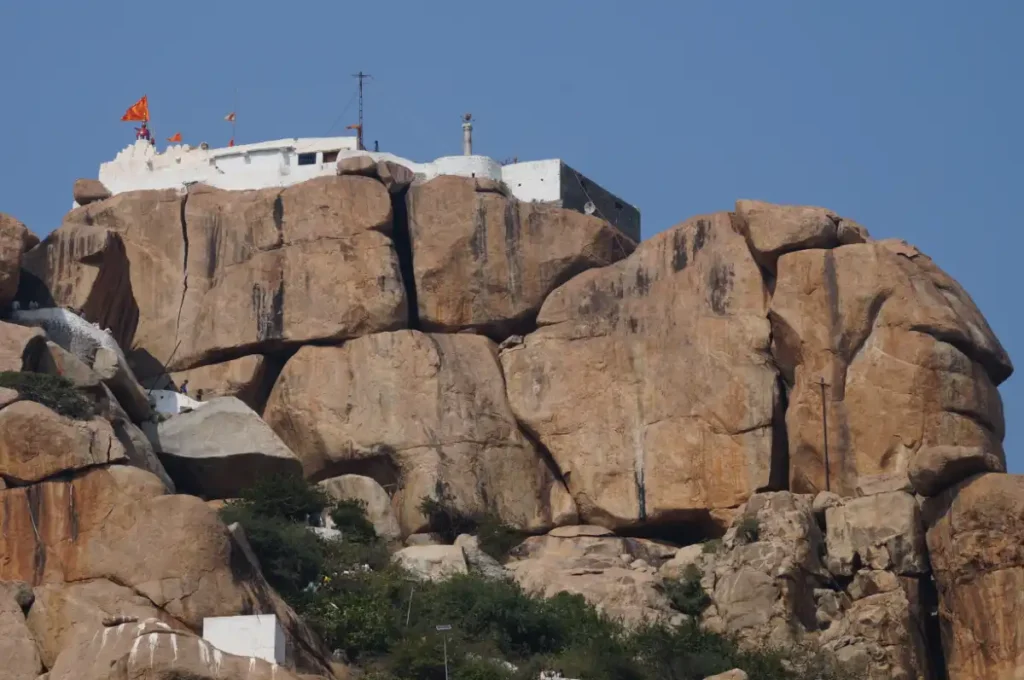
A Vijayanagara-era Hanuman temple crowns the hill. It is a simple, whitewashed building with a pyramid-shaped roof and a red dome. Inside, the main image of Hanuman is carved into the rock, and small shrines to Rama and Sita stand nearby. A shrine to Anjana Devi is also associated with the hill. Local belief mentions a stone that floats, said to come from Rama’s bridge to Lanka.
The temple is small, and the experience is quiet and devotional. Most people come for darshan, the hilltop atmosphere and the view rather than for grand architecture.
The climb: steps, time and what to expect
You reach the temple by a flight of stone steps cut along the hill. Counts differ by source: the Koppal district tourism page says about 462 steps, while several travel guides say about 575. Plan on roughly 460 to 575 steps. At a steady pace, the climb takes 45 to 60 minutes, with places to stop and rest along the way.
The steps are in good condition, and the climb is manageable for most fit visitors, but it is steep in places and hot by mid-morning. Older visitors and young children should go slowly and rest often.

Anjanadri Hill timings and entry fee
The temple is generally open every day from about 6 am to 6 pm. Entry is free. Timings can change on festival days, so check locally before you travel, especially if you are coming a long way.
Best time to visit Anjanadri Hill
October to March is the most pleasant season, with cooler mornings and clear views. Start before 8 am to avoid the heat, or climb in the late afternoon and stay for sunset, which is one of the finest views in the Hampi region. Summer is very hot, and the steps can be slippery during the monsoon.
How to reach Anjanadri Hill
Anjanadri Hill is about 3 km from Anegundi and about 23 km from Hampi by road. Hosapete (Hospet) is the usual railway gateway, about 35 km away. Cabs and auto-rickshaws are available from Hampi, Hosapete and Gangavathi, and buses run towards Anegundi and Gangavathi. Many visitors cross the Tungabhadra by coracle from the Hampi side and continue by road, though crossings may stop when the river is high.
| From | Distance and notes |
|---|---|
| Anegundi | About 3 km |
| Gangavathi | About 14 km, around 30 minutes by road |
| Hampi | About 23 km by road |
| Hosapete (Hospet) | About 35 km, around 50 minutes by road; the usual railway gateway for Hampi |
| Koppal | About 39 km, around 50 minutes by road |
| Nearest airport | Jindal Vijaynagar (Toranagallu), about 48 km; Hubballi, about 170 km |
| Highways | NH50, NH67 and SH130 serve the area |
Tips for visitors
- Carry drinking water and a few light snacks. Refreshments may be available near the top, but supplies are limited.
- Wear sturdy shoes with good grip. You will remove them at the temple.
- Dress modestly, with shoulders and legs covered.
- Keep food out of sight and do not feed or tease the monkeys. Hold on to phones, glasses and bags.
- Start early in the cooler months. Avoid the midday climb in summer.
- Photography is permitted. The best light is at sunrise and in the late afternoon.
Festivals and special days
Hanuman Jayanti is the biggest day of the year, when thousands of devotees climb the hill for special puja and abhishekam. The date varies by calendar and tradition, so check with the temple or local sources before planning a visit around it. Tuesdays and Saturdays, the days sacred to Hanuman, draw regular crowds, and Rama Navami is also observed. Expect long queues and a slow climb on festival days.
What to see near Anjanadri Hill
The hill makes a natural half-day trip, and the Anegundi side of the river has several places worth combining with it:
- Anegundi, the old village and Vijayanagara-era fortified settlement, a short drive away.
- Pampa Sarovar and the sites around Anegundi tied to the Kishkindha story.
- The ruins across the river, including the temples and bridge, covered in our guides to Hampi: Temples in Hampi, Hazara Rama Temple and the Ancient Bridge.
- The rest of Hampi is covered in our Top 15 Tourist Sites in Hampi.
Plans to develop Anjanadri Hill
The Karnataka government has announced budgets of Rs. 100 crore, first in February 2023 and again in February 2024, to develop Anjanadri Hill as a pilgrimage and tourism destination. Visitor facilities may change as this progresses, so check for the latest on access and timings before you go.
Frequently asked questions
Why is Anjanadri Hill famous?
Anjanadri Hill is revered as Lord Hanuman’s birthplace. It lies in the ancient Kishkindha region of the Ramayana, and a Vijayanagara-era Hanuman temple stands at its summit, reached by a long stone stairway.
Where is Anjanadri Hill located?
Anjanadri Hill is near Anegundi in Gangavathi taluk, Koppal district, Karnataka. It stands on the north bank of the Tungabhadra River, across from the main Hampi monuments.
How many steps are there to climb Anjanadri Hill?
Counts differ by source. The Koppal district tourism page says around 462 steps, while other guides give about 575. Plan on roughly 460 to 575 steps and a climb of 45 to 60 minutes at a steady pace.
What are the Anjanadri Hill timings, and is there an entry fee?
The temple is generally open from about 6 am to 6 pm every day, and entry is free. Timings can change on festival days, so check locally before you travel.
What is the best time to visit Anjanadri Hill?
October to March is the most comfortable season. Start before 8 am or climb in the late afternoon to avoid the heat and catch the sunrise or sunset views. Summers are very hot, and the steps can be slippery during the monsoon.
How far is Anjanadri Hill from Hampi?
The hill is about 23 km from Hampi by road and about 3 km from Anegundi. It is also roughly 35 km from Hosapete, the nearest major railway station for Hampi.
How do I reach Anjanadri Hill?
Hire a cab or auto-rickshaw from Hampi, Hosapete, or Gangavathi, or take a bus to Anegundi or Gangavathi. Many visitors cross the Tungabhadra by coracle from the Hampi side and continue by road. Jindal Vijaynagar Airport is about 48 km away.
How long does a visit take, and what should I carry?
Allow one to two hours, including the climb and darshan. Carry drinking water, wear sturdy footwear and dress modestly. Do not carry open food, as monkeys are common along the route.
