
Vijayanagara district is one of the newest districts in Karnataka, but it carries one of South India’s oldest and grandest legacies. Formally created in 2021, it takes its name from the medieval Vijayanagara Empire. It is best known as the home of Hampi, a UNESCO World Heritage Site that draws visitors from across the world.
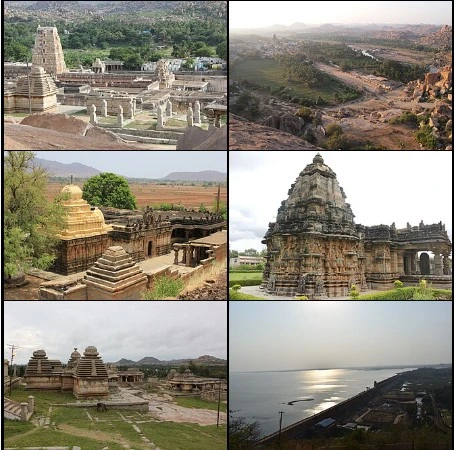
Table of Contents
Quick Facts
- Formed: 2021, carved out of the erstwhile Ballari district
- Status: 31st district of Karnataka
- Headquarters: Hosapete (Hospet)
- Taluks: Hosapete, Hagaribommanahalli, Harapanahalli, Kudligi, Kotturu and Hoovina Hadagali
- Major river: Tungabhadra
- Main language: Kannada, with Telugu and Urdu also spoken
- Famous for: Hampi monuments, Tungabhadra Dam, agriculture and mineral-based industry
Vijayanagara district history
The history of the Vijayanagara region begins around 1336, when the brothers Harihara I and Bukka Raya I founded the Vijayanagara Empire on the banks of the Tungabhadra. Over the following centuries, its capital, Vijayanagara—modern Hampi—developed into one of South India’s largest and most prosperous cities, known for its temples, bazaars, fortifications and sophisticated water-management systems. Under rulers such as Krishnadevaraya (1509–1529), the empire reached a cultural and political peak, and Kannada, Telugu and Sanskrit learning flourished.
The empire suffered a decisive defeat at the Battle of Talikota in 1565. The capital was subsequently sacked and ceased to function as a major urban centre, although the empire survived in reduced form for several decades. The wider region later came under the control of various powers, including the Deccan sultanates, the Nizam, the Marathas and the British, before becoming part of Ballari district.
Karnataka approved the creation of Vijayanagara district in 2020, and it officially became the state’s 31st district on 2 October 2021, with Hosapete as its headquarters. The new district revived the historic name associated with the Vijayanagara Empire.
Climate & Geography
The district lies in northern interior Karnataka, on the fringe of the Deccan Plateau. It is located in the Kalyana Karnataka region. Its landscape mixes rocky hills, boulder-strewn ridges and fertile river plains. The Tungabhadra is the lifeline of the region, feeding canals that irrigate large tracts of farmland.
The climate is semi-arid. Summers from March to May are hot, often crossing 40°C, while winters are mild and pleasant. Rainfall is moderate and concentrated in the southwest monsoon months. The best time to explore Vijayanagara District is between October and February, when the weather is cooler and ideal for sightseeing.
Economy
Agriculture is the backbone of the local economy of Vijayanagara. Farmers grow paddy, maize, cotton, groundnut, sunflower and pulses, and the Tungabhadra Dam near Hosapete supplies irrigation water and hydroelectric power. The reservoir is also vital for drinking water across the region.
Industry and mining add further strength. The iron-ore belt around Hosapete has long supported mining, steel and related small industries, creating jobs beyond farming. Tourism is the third pillar: hotels, homestays, guides, transport operators and craft sellers around Hampi depend on year-round visitors. Together, these sectors make the Vijayanagara district a balanced mix of farming, industry and heritage-driven services.
Vijayanagara district tourism
Tourism is Vijayanagara’s showpiece.
- Hampi: A sprawling UNESCO site of ruined temples, royal enclosures, markets and boulder landscapes. Delve deeper into the information about Hampi here.
- Virupaksha Temple: An active temple that has been in continuous worship for centuries. Read about Virupaksha temple in detail here.
- Vittala Temple: Home to the iconic stone chariot and musical pillars. For more details about the Vittala temple click here.
- Tungabhadra Dam: A scenic reservoir with gardens and sunset views.
- Daroji Bear Sanctuary: A protected habitat for the sloth bear, near Kamalapura. Read more about the sanctuary here.
- Hampi Utsav: A cultural festival celebrating music, dance and the region’s heritage.
Hosapete, the district headquarters, has a railway station and is the most convenient base for travellers.
Administration
The district of Vijayanagara is headed by a Deputy Commissioner, who oversees revenue, development and law and order, supported by a Superintendent of Police and a Zilla Panchayat Chief Executive Officer. Administration is organised through six taluks, each managed by a tahsildar, with grama panchayats at the village level. Hosapete serves as the administrative hub, hosting the main district offices and services. The district also has multiple assembly constituencies that represent its people in the Karnataka Legislative Assembly.
