Mysore Dasara is the Nada Habba, or state festival, of Karnataka: ten days of worship, pageantry and public celebration in Mysuru (Mysore) that end on Vijayadashami with the Jamboo Savari, the elephant procession through the city. Devotees believe the festival marks the victory of Goddess Chamundeshwari over the buffalo demon Mahishasura, the legend that also gives the city its name.
This guide covers the history of Mysore Dasara from the Vijayanagara kings to the present day, the rituals still kept inside Mysore Palace, the Jamboo Savari and the festival’s other traditions, and every karnataka.com guide to Dasara in one place. For this year’s day-by-day schedule, timings and tickets, see our guide to the festival dates for 2026.
Key Takeaways
- Mysore Dasara is the Nada Habba (state festival) of Karnataka, celebrated in Mysuru through Navaratri and ending on Vijayadashami with the Jamboo Savari.
- Its roots lie in the Mahanavami festival of the Vijayanagara kings. Raja Wadiyar I first celebrated Dasara at Srirangapatna in 1610.
- Since the 1970s, the Government of Karnataka has organised Mysore Dasara, and the idol of Goddess Chamundeshwari, rather than the king, rides in the golden howdah.
- The Wadiyar family still keeps a private Navaratri at Mysore Palace, with the golden throne and a nightly Khas Durbar.
- Mysore Dasara 2026 runs from 11 to 21 October, with the Jamboo Savari on 21 October.
- Most of Mysore Dasara is free to watch. Only a few seated events are ticketed.
Table of Contents
Mysore Dasara 2026 at a glance
Mysore Dasara 2026 runs from Sunday, 11 October to Wednesday, 21 October. It opened with the Chamundeshwari puja on Chamundi Hill on 11 October, and the Jamboo Savari and the closing Torchlight Parade fall on Vijayadashami, 21 October. As of October 2026, the Mysuru Dasara Committee lists more than 90 programmes across the city in its official schedule. Day-by-day timings, the procession route and ticket prices are in our 2026 schedule and tickets guide.
What is Mysore Dasara?
Dasara is the South Indian name for the festival that much of India calls Dussehra or Vijayadashami. It closes Navaratri (the nine nights), during which the Goddess is worshipped in her different forms. In Mysuru the festival has a royal and civic character that sets it apart: the palace, the hill temple and the city’s streets become one stage, and the Government of Karnataka organises it as the Nada Habba, the festival of the land.
The festival is described officially as ten days and nine nights. Because the festival follows the lunar calendar, its dates move each year, usually into September or October, and its exact span depends on how the tithis (lunar days) fall. This year it runs for 11 days, from 11 to 21 October.
Dasara in Mysuru is also one of Karnataka’s largest public events. Alongside the religious observances, the festival brings an illuminated city, the Dasara Exhibition, food and flower shows, sports, cultural stages and folk performances, and most of them are free.
The legend behind Mysore Dasara
According to the Devi Bhagavata and local tradition, the region was once ruled by Mahishasura, a buffalo-headed demon. In answer to the prayers of the gods, the Goddess took the form of Chamundeshwari, a fierce form of Durga, and slew Mahishasura on the hill above the city. Devotees believe she has remained on the hill ever since, at the Chamundeshwari Temple on Chamundi Hills.
The legend also explains the city’s name. Mysuru is traditionally derived from Mahishuru, or Mahishasurana ooru, meaning the town of Mahishasura in Kannada. The festival honours the Goddess’s victory, which devotees see as the triumph of good over evil, and Vijayadashami, the day of victory, marks it.
History of Mysore Dasara
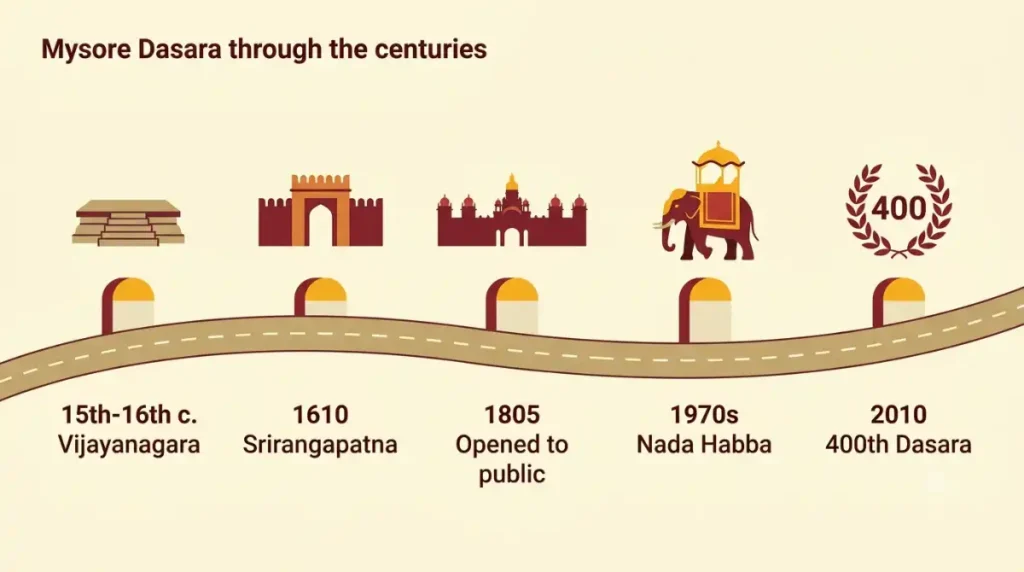
The history of Mysore Dasara spans more than four centuries in Mysuru, and reaches further back to the Vijayanagara Empire. The account below follows the official timeline published by the Mysuru Dasara Committee, Government of Karnataka, on its Dasara History and Legacy page.
Mahanavami in Vijayanagara
In the 15th and 16th centuries, the Vijayanagara emperors celebrated Mahanavami at their capital, Hampi, as a nine-day display of military strength and royal splendour. The Persian envoy Abdur Razzaq, who visited Vijayanagara in the 1440s, described the festival in the account of his travels. The stone platform from which the kings watched the celebrations still stands in Hampi’s Royal Enclosure as the Dasara Dibba, also called the Mahanavami Dibba.
Raja Wadiyar I and the first Mysore Dasara at Srirangapatna (1610)
Vijayanagara fell in 1565, and its feudatories, among them the Wadiyars (also spelt Wodeyars) of Mysore, carried the tradition with them. According to the official history, Raja Wadiyar I first celebrated Dasara at Srirangapatna in 1610. The Mysuru tradition is counted from that year, and the 400th Dasara was celebrated in 2010. Read more about the Wodeyar kings of Mysore.
Krishnaraja Wadiyar III and the public Dasara
After the fall of Tipu Sultan in 1799, the Wadiyars returned to the throne and the Dasara Durbar (royal assembly) resumed. Krishnaraja Wadiyar III gave the celebration its modern shape in the city of Mysuru, and in 1805, according to the official timeline, he opened it to the public.
Krishnaraja Wadiyar IV and the Dasara spectacle
Under Krishnaraja Wadiyar IV, who ruled in the first decades of the 20th century, Dasara grew into the public spectacle it is today, with the procession, the illuminated city and the rebuilt Mysore Palace at its centre. The Dasara Exhibition also dates from the royal era: it was started in 1880 under Chamaraja Wadiyar X to bring new ideas and industry to the people of Mysore, and the Karnataka Exhibition Authority runs it today.
From royal festival to Nada Habba
Jayachamarajendra Wadiyar presided over the last royal Dasara in the 1940s, before the princely state of Mysore acceded to India. Since the 1970s, the State Government has organised Dasara as the Nada Habba, with the Mysuru District Administration running the festival. The same decade brought the change visitors see today: the idol of Goddess Chamundeshwari, rather than the king, rides in the golden howdah during the Jamboo Savari.
Table 1 – Mysore Dasara through the centuries
| Period | Milestone |
|---|---|
| 15th – 16th centuries | Vijayanagara emperors celebrate Mahanavami at Hampi |
| 1565 | Vijayanagara falls; feudatories, including the Wadiyars, carry the tradition |
| 1610 | Raja Wadiyar I first celebrates Dasara at Srirangapatna |
| 1799 | Wadiyars return to the throne after Tipu Sultan; the Dasara Durbar resumes |
| 1805 | Krishnaraja Wadiyar III opens the Mysuru celebration to the public |
| 1880 | Dasara Exhibition started under Chamaraja Wadiyar X |
| 1940s | Last royal Dasara, under Jayachamarajendra Wadiyar, before Mysore accedes to India |
| 1970s | State Government organises Dasara as the Nada Habba; the goddess replaces the king in the howdah |
| 2010 | 400th Mysore Dasara |
| Source: Mysuru Dasara Committee, Government of Karnataka (mysoredasara.gov.in/about), as of October 2026. The 1880 Exhibition date comes from historical accounts and is not listed on the official site. | |
Mysore Dasara at the Palace: the royal Navaratri
Alongside the public festival, the Wadiyar family keeps a private Navaratri inside Mysore Palace, continuing the traditions of the court. According to the Mysuru Dasara Committee, the Ratna Simhasana (the golden throne) is assembled in the Durbar Hall nine days before Navaratri, and the scion of the family ascends it on the first night. Each night of Navaratri the family holds the Khas Durbar (private assembly), with music, ritual offerings and the presentation of the royal sword.
On Mahanavami, the ninth day, the Palace performs Ayudha Puja (the worship of weapons and tools) along with pujas to the royal elephants, horses and other emblems of the state. Vijayadashami brings the Shami puja, the worship of the shami (banni) tree, and the Aparajita puja. The Khas Durbar is a private observance, though the official Navaratri page notes that evening tickets admit visitors to the Palace galleries. In 2026, Mahanavami falls on 20 October and Vijayadashami on 21 October.
The Jamboo Savari: the Mysore Dasara procession
The Jamboo Savari is the climax of Mysore Dasara. On the afternoon of Vijayadashami, the Chief Minister performs the Nandi Dhwaja puja (worship of the Nandi flag) at the Palace and then offers flowers to the idol of Goddess Chamundeshwari, seated in the golden howdah on the lead elephant. The procession then leaves the Palace and travels about 5 km through the city to Bannimantap, where the banni tree has traditionally been worshipped.
The howdah, known as the Mysore Ambari, carries about 750 kg of gold, according to the official site. The elephants come from forest camps such as Dubare and Mattigodu, and their journey to Mysuru in August, the Gaja Payana, opens the Dasara season. Read about the Dasara elephants and about Arjuna, who carried the howdah for many years.
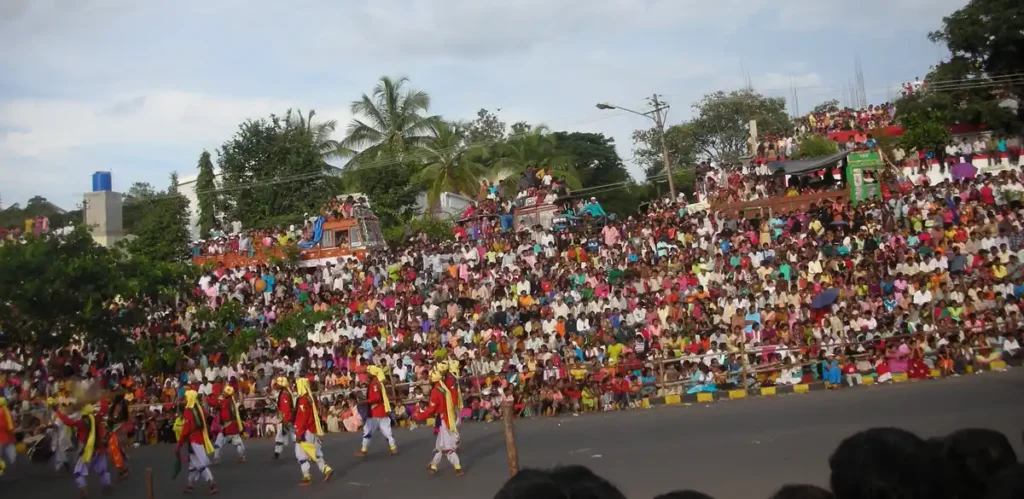
Tableaux from the districts, folk troupes, bands, mounted police and decorated elephants walk ahead of the howdah. Watching from the route is free; seats in the Palace forecourt and at Bannimantap are ticketed. The Jamboo Savari 2026 timings, route and tickets are in our dates guide.

Torchlight Parade, illumination and the Dasara Exhibition
Torchlight Parade (Panjina Kavayathu)
The festival closes the same night at the Bannimantap parade grounds with the Torchlight Parade, Panjina Kavayathu in Kannada: a display by mounted cavalry, police bands and stunt teams, ending in fireworks. Under the Wadiyars the salute was taken by the Maharaja; today a state dignitary takes it. Read more about the Mysore Dasara parade.
Illumination
Through the festival, Mysore Palace is lit every evening, and the city’s main streets carry the Deepalankara (festive lighting). Viewing the illuminated Palace from outside is free.
Dasara Exhibition
The Dasara Exhibition is held on the Exhibition Grounds near the Palace, with stalls, government pavilions and amusement rides, and usually stays open well after the festival ends. Its dates, timings and entry fee are announced separately each year.
Dasara traditions at home
Across Karnataka, many families mark Dasara with the gombe habba, a display of dolls on tiered steps that traditionally includes a pair of wooden pattada gombe (royal couple dolls). Read about the Dasara doll festival and ideas for arranging Dasara dolls. On Mahanavami, homes, shops and workplaces also observe Ayudha Puja, worshipping the tools of their trade, and Vijayadashami is traditionally considered an auspicious day to begin learning.
Dasara beyond Mysuru
Mysore Dasara is the best known, but Dasara is celebrated across Karnataka in its own ways. In Mangaluru (Mangalore), the festival is known for huli vesha, the tiger dance; read about the tiger dance of Mangaluru Dasara. In Hampi, the Mahanavami platform of the Vijayanagara kings still stands. For how the festival is kept elsewhere in India, from Durga Puja to Ramlila, and for the state’s wider festival calendar, see our guide to the festivals of Karnataka.
Visiting Mysuru for Mysore Dasara
Mysuru is about 140 km from Bengaluru (Bangalore), roughly three hours by road or about two hours on the fastest trains. Trains and rooms fill early for the last two days of the festival, so book ahead. Between events, visit the Palace by day, plan your days with our guide to local sightseeing in Mysore, find a meal at restaurants near Mysore Palace, or join a guided Dasara walking tour. For an overview of the city, read Mysore: of history and places.
Mysore Dasara guides on karnataka.com
Our main Dasara guides, grouped by what you want to know.
Dates, schedule and tickets
- Mysore Dasara dates 2026: day-by-day schedule, Jamboo Savari and tickets: every major event, timings, the Gold Card and ticket prices, parking and helplines.
The procession, elephants and howdah
- Dasara elephants: the Gaja Payana, training and the Dasara elephants.
- Mysore Ambari, the golden howdah: the howdah and the elephants that carry it.
- The tale of Arjuna: the long-serving howdah elephant.
- The Dasara parade: the Jamboo Savari and the Torchlight Parade.
Rituals and traditions
- Ayudha Puja: the worship of tools and weapons on Mahanavami.
- Dasara doll festival and Dasara doll arrangement ideas: the gombe habba at home.
- Tiger dance at Mangaluru Dasara: huli vesha on the coast.
History and the royal family
- The Wodeyar kings of Mysore and Raja Wodeyar I, who began the Dasara at Srirangapatna.
- Maharaja Krishnaraja Wadiyar IV, under whom Dasara became a public spectacle.
- The Royal Carnatic Orchestra: the palace’s own orchestra.
- Dasara Dibba, Hampi: the Vijayanagara Mahanavami platform.
Mysuru for visitors
- Mysore Palace, the Chamundeshwari Temple and Chamundi Hills.
- Local sightseeing in Mysore and restaurants near Mysore Palace.
- Dasara walking tour and Mysore: of history and places.

Dasara Related Links
- The Tale Of Arjuna – The Star Elephant Of Dasara
- Dasara Events Schedule
- Dasara Doll Festival
- Mysore Dasara Walking Tour
- Where to buy Dasara Dolls?
- Restaurants near Mysore Palace
- Elephant March during Dasara
- Ayudha Pooja
- Festivals of Karnataka
- The Life and Achievements of Maharaja Sri Krishnaraja Wadiyar-IV
- The Royal Carnatic Orchestra – A Fusion of Classic and Western Music
- The Life and Times of Raja Wodeyar I – The 9th Maharaja of Mysore
FAQ: Mysore Dasara
What is Mysore Dasara?
It is the Nada Habba, or state festival, of Karnataka, celebrated in Mysuru through Navaratri and ending on Vijayadashami with the Jamboo Savari, the procession that carries the idol of Goddess Chamundeshwari in a golden howdah.
When did Mysore Dasara start?
According to the official history, Raja Wadiyar I first celebrated Dasara at Srirangapatna in 1610, continuing the Mahanavami tradition of the Vijayanagara kings. The 400th Dasara was celebrated in 2010.
Why is Mysore Dasara called the Nada Habba?
Nada Habba means the festival of the land, or state festival. Since the 1970s, the Government of Karnataka has organised the festival as the state’s official festival, with the Mysuru District Administration running it.
What is the significance of Mysore Dasara?
Devotees believe the festival marks the victory of Goddess Chamundeshwari over the demon Mahishasura, which is seen as the triumph of good over evil. The festival also carries more than 400 years of the Wadiyar court’s traditions.
What is the Jamboo Savari?
The Jamboo Savari is the procession on Vijayadashami that closes the festival. The idol of Goddess Chamundeshwari rides in the golden howdah on the lead elephant for about 5 km, from Mysore Palace to Bannimantap.
When is Mysore Dasara in 2026?
This year’s festival runs from 11 to 21 October, with the Jamboo Savari and the Torchlight Parade on 21 October. Our 2026 dates guide has the full schedule and ticket prices.
Can I watch Mysore Dasara for free?
Yes. Watching the Jamboo Savari from the route, the illuminated Palace from outside and most cultural programmes is free. Only a few seated events, such as the Palace forecourt seats and the Torchlight Parade enclosures, are ticketed.