Navaratri is a major Hindu festival celebrated differently across India, with each state following its own names and customs. In southern India, one of its most beloved traditions is displaying dolls on a stepped platform. In Karnataka, this is the Dasara doll festival, known in Kannada as Bombe Habba or Gombe Habba. Tamil Nadu calls the same tradition Golu or Bommai Kolu, and Andhra Pradesh and Telangana call it Bommala Koluvu.
The festival spans the nine nights of Navaratri and ends on Vijayadashami, or Dasara, which marks Goddess Durga’s victory over the demons (asuras) after nine days of battle.

The Dasara Doll Festival of Karnataka
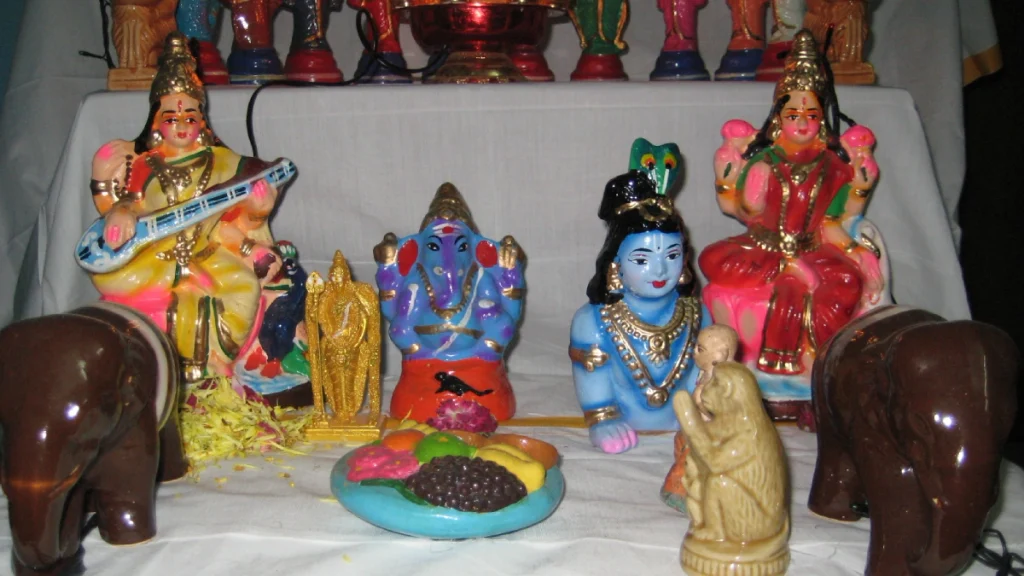
The Dasara doll festival is celebrated in Karnataka through an exhibition of various dolls and figurines arranged as per custom. The dolls are arranged and exhibited on a stepped platform having an odd number of steps or tiers (usually 7, 9 or 11) and usually covered with a white or light-coloured cloth. Many households use nine steps to display dolls, signifying the nine nights of Navaratri. People ritually worship the dolls during the celebrations.
The main dolls of the festival are a pair depicting a husband and a wife, called Pattada Gombe in Kannada. Parents give this pair to their daughter at her wedding, so that she can start her own collection and carry the tradition into her new home.
The Pattada Gombe pair is a set of traditional wooden dolls. These dolls are dressed colourfully using paper or silk textiles. The main pair of dolls is always dressed in traditional attire. Tradition reserves the top steps of the platform for miniature idols or dolls depicting gods and goddesses. Generally, the idols of Rama, Lakshmana, Seeta, Krishna, Radha, Shiva, Vishnu, Durga, Lakshmi, Saraswati, etc. are used in this festival. It is also customary to have a few wooden dolls in the collection.
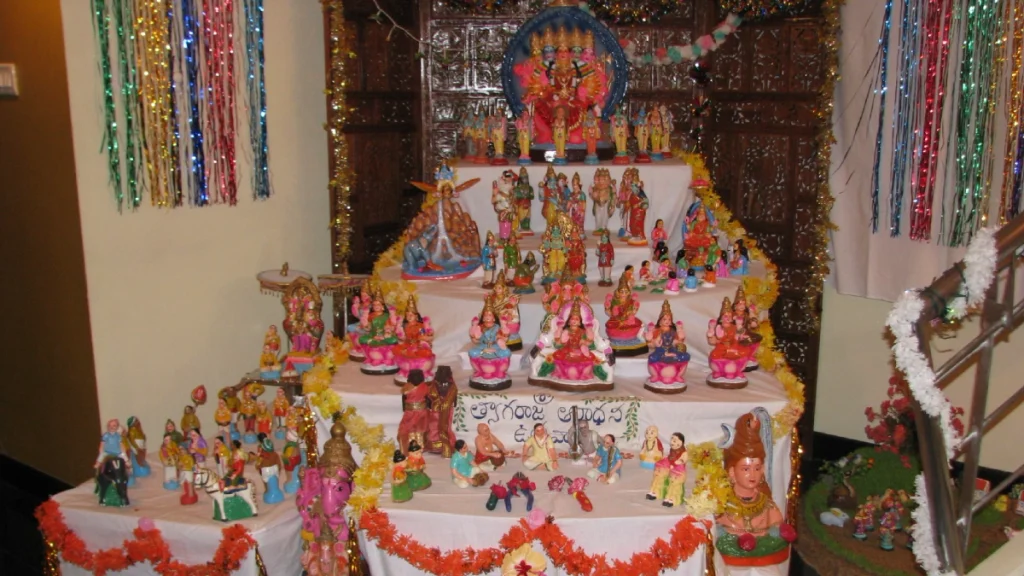
Dasara Doll Steps -The Arrangement of Dolls on the Tiers
Every home selects an auspicious time to begin the doll festival. The dolls are arranged as per a specific order on the tiers or steps. The hierarchy starts with the Gods being placed at the top tiers and ends with mortals of earth placed at the lower tiers of the platform.
Steps 1 to 3: The first three steps are dedicated to figurines or idols of Gods and Goddesses. These steps hold idols of various gods and goddesses.
Steps 4 to 6: The next three steps are used to arrange dolls depicting demigods, great saints or kings and queens. Due importance is given to the Mysore kings during this festival, and their miniature forms are generally seen placed on these steps.
Step 7: This step is devoted to showcasing Hindu festivals, celebrations and occasions.
Step 8: This step is decorated with scenes from everyday life, such as a park, a shop, a vegetable vendor, etc.
Step 9: The last step usually depicts the evolution of mankind or living things.
There is no hard-and-fast rule for arranging the dolls. Each household generally increases or decreases the number of stairs based on the rows or tiers needed to display the dolls available to them.
The History Associated with the Doll Festival
Legend says Goddess Durga waged war against the demon Mahishasura. To help her, all the Gods and Goddesses gave her their powers. As the Gods and Goddesses became powerless, they stood as statues. Durga triumphed over Mahishasura on the 10th day of the war, which is celebrated as Dasara. To honour these deities’ self-sacrifice, people observe the doll festival by worshipping the Gods and Goddesses in the form of dolls. The custom is popularly traced back to the time of the Vijayanagara Empire.
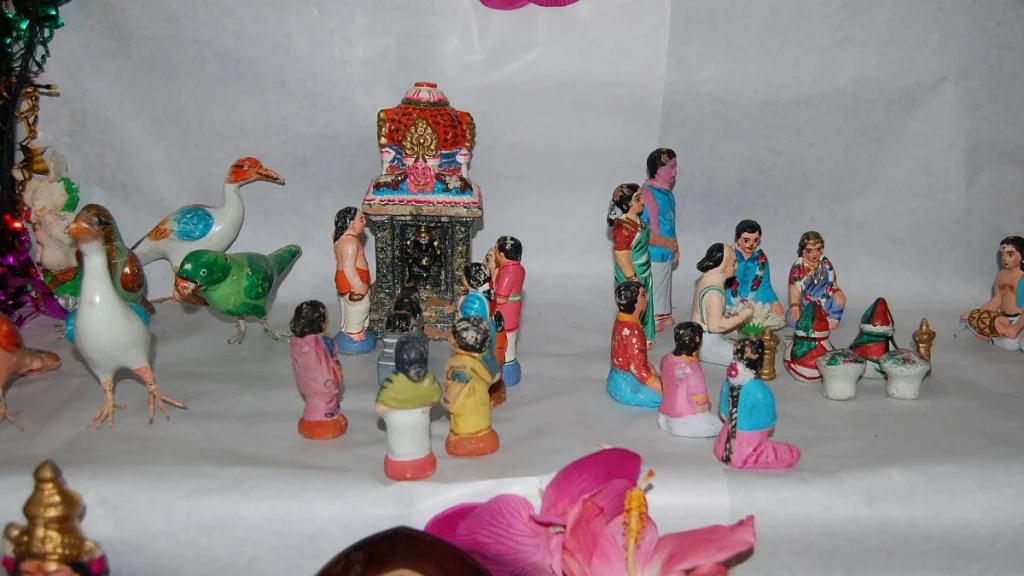
Customs Followed in the Doll Festival
Most households follow a theme when arranging dolls. Some households follow a simple, traditional theme, while others present their dolls in elaborate, extravagant ways. People use their creativity to showcase their collection in unique, attractive ways. Some people depict stories from the Ramayana and Mahabharata in rows on the platform. These days, people also exhibit dolls with modern themes like saving the environment or reducing pollution.
Every year, people add a new set of dolls to their collection. As a result, each household’s collection grows every year. Dolls are passed down from one generation to the next. As such, some families have dolls that are more than 100 years old.
During Navaratri, people invite friends and family to visit and enjoy each family’s unique doll exhibition. Each day, the family offers a prasad to the dolls, which is distributed among family members, neighbours, and guests.
Significance of the Doll Festival celebration
Karnataka follows the doll festival in a way that is rooted in tradition and introduces the new generation to the rich culture and mythology of the land. It also seeks divine blessings and entertains children during the Dasara festival.
The craft of traditional doll making is diminishing by the day. Mysore becomes a land of dolls during Dasara. The festival keeps the craft of wooden and clay doll-making alive and lets grown-ups become children for a few days each year.
Also see,