Most people are told that Bengaluru began in 1537, when Kempegowda I laid out his mud fort and four watchtowers. A weathered slab of granite in a temple courtyard in south Bengaluru says otherwise. The Begur Panchalingeshwara Temple holds the oldest known written record of the name Bengaluru — a hero stone carved around 890–900 CE, more than six centuries before Kempegowda drew his first furrow.
The complex sits barely 12 kilometres from MG Road, tucked behind a busy stretch of Begur Main Road off Hosur Road. There is no ticket counter, no crowd, and very little signage. Yet for anyone interested in how this city actually began, it is arguably the single most important site in Bengaluru.
| Quick take A cluster of Shiva shrines built under the Western Ganga dynasty in the 9th and 10th centuries CE, expanded by the Cholas, Hoysalas and Vijayanagara rulers, and home to a hero stone bearing the earliest surviving mention of “Bengaluru”. Protected by the Archaeological Survey of India. |
Table of Contents
Why the Begur Panchalingeshwara Temple Matters
Begur is older than its temple. Inscriptions record the settlement under the names Bempur, Veppur and Behur, and a copper plate dated 517 CE — catalogued as Doddaballapur inscription no. 68 in Volume 9 of Epigraphia Carnatica — is the earliest documentary trace of the village. Through the Ganga centuries it functioned as Bempur-naadu, an administrative division governing a cluster of twelve villages, several of which are still recognisable on a Bengaluru map today: Togur, Hulimangala, Saraki, Elkunte and Kudlu among them.
That administrative weight is why so much epigraphy survives here. The Begur Panchalingeshwara Temple precinct holds one of the densest concentrations of early inscriptions and hero stones anywhere in the Bengaluru region, spanning the Western Gangas in the 9th century through to Vijayanagara-era records in the 15th and 16th.
The Inscription That Named Bengaluru
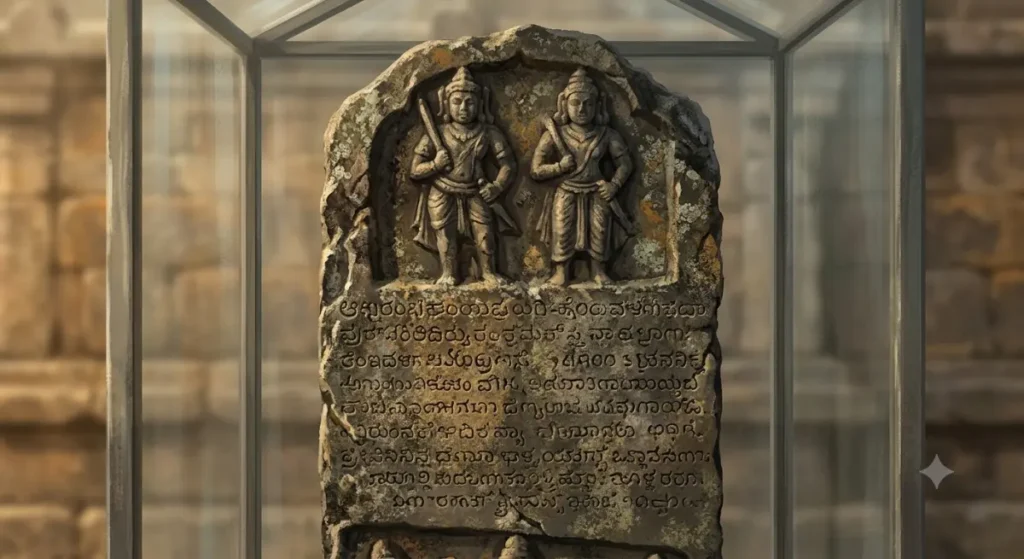
The famous stone is a viragallu, or hero stone, raised in memory of two men — Pervvonashetti and Buttanapati, sons of the local chieftain Nagatara — who died in what the text calls the battle of Bengulooru. It was identified in the mid-1910s by the epigraphist R. Narasimhachar and published in Epigraphia Carnatica, Volume 9 Supplement, as Bangalore inscription no. 174.
Narasimhachar understood immediately what he had. The prevailing story at the time traced the city’s name to a Hoysala king, Ballala, and a legendary bowl of boiled beans — benda kaalu ooru. The Begur stone made that impossible to sustain as history. A place called Bengaluru already existed, and was already worth fighting over, roughly a thousand years ago.
The inscription does not settle everything. It records a battle at or around Bengaluru, but does not say whether the fighting happened inside a settlement of that name or over control of the wider area. That ambiguity is still debated by scholars including M.G. Manjunath, S. Karthik and S.V. Padigar. What it does establish beyond doubt is the antiquity of the name itself.
Where to see the Begur Panchalingeshwara Temple inscription today
The stone remains in the temple precinct. Until 2018, it stood largely unprotected; INTACH Bengaluru then installed a glass gazebo on the southern side of the temple, and the principal inscription stones are now sheltered there. Two other Begur hero stones, including the large Nagatara memorial, are held at the Government Museum on Kasturba Road.
Who Built the Begur Panchalingeshwara Temple?
Two of the shrines in the complex were commissioned under Western Ganga kings — Nitimarga I, who ruled roughly 843 to 870 CE, and Ereyappa Nitimarga II, who ruled roughly 907 to 921. A separate inscription found during foundation clearance work in the mid-1990s, and published by the historian Dr Devarakonda Reddy, credits the construction of the original Somanatha temple, now the Nageshwara shrine, to the chieftain Nagatara around 900 CE.
Nagatara is the human centre of the whole site. He governed Bempur under Ganga overlordship, is named in at least ten inscriptions across Bengaluru, and is hailed in one of them as Kaliyuga Hanumanta. He built the temple to mark a victory over a rival named Beeravarma, endowed it with land and tax revenues, and handed its custody to a priest, Divyasakti Bhatta, through a ceremonial foot-washing ritual called kalamkalchi.
He died in battle at Tumbepadi, charging the enemy line and being killed by a war elephant. King Ereyappa honoured the sacrifice by conferring the Nagatara title on his kinsman Iruga and granting him the twelve villages of Bempur. The story of the family runs through the site: the father’s hero stone, the sons’ hero stone that names Bengaluru, and a fourth stone recording that Nagatara’s daughter Tondabbe ended her life through the Jain rite of sallekhana.
Five Lingas, Many Dynasties
The name Panchalingeshwara refers to five Shiva lingas. The Begur Panchalingeshwara Temple is really a courtyard of shrines rather than a single building. In practice, the complex grew well past five shrines as successive dynasties added to it. Alongside the Nageshwara sanctum stand shrines to Nagareshwara, Choleshwara, Karneshwara, Kalikamba, Kali-Kammateshwara, Parvati and Suryanarayana — a layering of Ganga, Chola, Hoysala and Vijayanagara patronage in a single courtyard. The Choleshwara name is the clearest marker of the Chola period, when Tamil inscriptions begin to appear at the site.
Architecture and Sculpture
The Nageshwara shrine follows a compact early plan: a square sanctum, a vestibule, a closed hall and an open hall entered by balustraded steps at the south-west and north-west corners. Six unequally spaced granite pillars carry the open hall, square at the base and fluted octagonal at the centre, with a Nandi on a lotus platform in the outer bay.
The ceilings are where the Ganga hand is most visible. The closed hall carries the ashta-dik-palaka — the eight guardians of the directions — set in a square grid, with a four-armed Uma-Maheshwara among them. The open-hall ceiling repeats the grid with Shiva and Parvati seated at the centre. Loose sculptures in the hall include a Mahishasuramardini, a Kalabhairava, and an unusual two-armed Ganesha.
Look at the doorway before you go in. The jambs carry creepers with ganas looped through them, and lotus terminations, and a Gajalakshmi flanked by elephants sits at the centre of the lintel. The adjoining Nageshwarasvami shrine has Ganga and Yamuna figures with attendants at the base of its entrance — a Chalukya–Rashtrakuta convention that shows how porous these regional styles were.
Key Inscriptions at Begur
| Inscription | Date | What it records | Where it is now |
|---|---|---|---|
| Pervvonashetti and Buttanapati’s hero stone | c. 890-900 CE | Deaths of Nagatara’s sons in the “Bengulooru” battle – earliest known written use of the name Bengaluru | Temple precinct, Begur |
| Nagatara’s Somanatha temple inscription | c. 900 CE | Construction of the temple after victory over Beeravarma; grants of land and tax revenue | Temple precinct, Begur |
| Nagatara’s hero stone | c. 900 CE | His death at the battle of Tumbepadi; grant of the twelve Bempur villages to Iruga | Government Museum, Bengaluru |
| Tondabbe sallekhana inscription | c. 900 CE | Death of Nagatara’s daughter by the Jain rite of sanyasana – rare Jain record in Bengaluru | Mantapa pillar, Begur fort entrance |
| Bydukura Kerega hero stone | c. 900 CE | Death defending the village and its cattle (turugol and uralivu) | Government Museum, Bengaluru |
| Gowdu Sonnappa donation record | c. 1400 CE | Gift of ritual vessels – plate, stand, conch, incense stand – to the Nageshwara temple | Nageshwara temple doorframe |
| Chokkimayya Jinalaya inscription | 1426 CE | Donation to a Jain basadi, evidence of a continuing Jain presence | Begur |
| Table 1: Principal inscriptions associated with the Begur Panchalingeshwara Temple complex. | |||
Conservation and the 3D Archive
Bengaluru’s expansion has been hard on its stones, and the Begur Panchalingeshwara Temple has fared better than most sites only because so much of its epigraphy stayed inside the precinct. Many inscriptions recorded a century ago have been lost, damaged or shifted from their original spots. Since 2021, the Mythic Society has run the Bengaluru Inscriptions 3D Digital Conservation Project, scanning surviving stones at high resolution both to preserve them digitally and to help decipher worn characters. The Begur inscriptions have been re-read under this project and published through its Akshara Bhandara software, and several previously undocumented stones elsewhere in the city have surfaced as a result.
The complex itself is a centrally protected monument under the Archaeological Survey of India, with additional oversight from the Karnataka Department of Archaeology, Museums and Heritage.
Begur at the 2026 Lalbagh Flower Show
If the temple looks familiar, that may be because a floral recreation of it is currently the centrepiece of the Lalbagh Flower Show running from 6 to 17 August 2026, whose theme is the glory of the Ganga Empire. Around six lakh flowers went into the model. Begur also featured in the Republic Day show in 2023. It is a good moment to make the short trip and see the original — which, unlike the Glass House version, is free to enter and rarely crowded.
Plan Your Visit to the Begur Panchalingeshwara Temple
| Detail | Information |
|---|---|
| Full name | Sri Panchalinga Nageshwara Temple, Begur (locally Naganatheshwara) |
| Address | Begur Main Road, Begur, Bengaluru 560068 |
| Distance from city centre | About 12 km from MG Road; about 15 km from Kempegowda Bus Station |
| Nearest metro | Hongasandra, Yellow Line (Namma Metro) – then a short auto ride |
| By bus | BMTC services from Majestic and Shivajinagar towards Begur and Bommanahalli |
| By road | Off Hosur Road via Bommanahalli; on-site parking available |
| Timings | Generally 6:00 AM-12:00 PM and 5:00 PM-8:00 PM (to be confirmed) |
| Entry fee | Free |
| Time needed | 45-60 minutes to see the shrines, the ceilings and the inscription gazebo |
| Best time to visit | October to March; early morning for light and quiet |
| Busiest days | Maha Shivaratri, Pradosha days and the Karthika month |
| Photography | Generally permitted in the precinct; ask before photographing inside the sanctum |
| Table 2: Practical information for visiting the Begur Panchalingeshwara Temple. | |
What to See Nearby
- Begur Lake — recorded as Veppur Periya Eri in a 12th-century Tamil inscription, and the reason the settlement grew where it did.
- The Begur fort mantapa — where the Tondabbe sallekhana pillar stands.
- Government Museum, Kasturba Road — holds the Nagatara and Bydukura Kerega hero stones.
- Bannerghatta National Park — about 15 km south, if you want to make a full day of it.
Why It Deserves a Visit
The Begur Panchalingeshwara Temple asks very little of a visitor: no queue, no fee, an hour of your morning. What it offers in return is a rare thing in a city that rebuilds itself every decade — a piece of physical evidence that Bengaluru is not a young place. The name on that stone was already worth going to war over eleven hundred years ago. Standing in front of it puts the rest of the city in a different light.
Frequently Asked Questions
Where is the Begur Panchalingeshwara Temple located?
The Begur Panchalingeshwara Temple is on Begur Main Road in Begur, Bengaluru 560068, roughly 12 km from MG Road and just off Hosur Road near Bommanahalli. The nearest Namma Metro station is Hongasandra on the Yellow Line.
Why is the Begur Panchalingeshwara Temple historically important?
It holds a hero stone dated to around 890–900 CE that refers to a battle of “Bengulooru” — the earliest known written use of the name Bengaluru. That pushes the documented history of the city’s name back more than six centuries before Kempegowda I founded his fort in 1537.
Who built the Begur Panchalingeshwara Temple?
Two shrines were commissioned under the Western Ganga kings Nitimarga I (r. 843–870 CE) and Ereyappa Nitimarga II (r. 907–921 CE). An inscription credits the original Somanatha shrine, now the Nageshwara temple, to the local chieftain Nagatara around 900 CE. Later shrines were added under the Cholas, Hoysalas and Vijayanagara rulers.
Who discovered the Begur inscription?
The epigraphist R. Narasimhachar identified the inscription in the mid-1910s. It was published in Epigraphia Carnatica, Volume 9 Supplement, as Bangalore inscription no. 174, and has since been re-read by the Mythic Society as part of its 3D digital conservation project.
What does Panchalingeshwara mean?
Panchalingeshwara means “lord of the five lingas”. The complex is named for its five Shiva lingas, though it grew over time to include additional shrines such as Nagareshwara, Choleshwara, Karneshwara, Kalikamba, Parvati and Suryanarayana.
What are the Begur Panchalingeshwara Temple timings?
The temple is generally open in the morning and again in the evening, with reported timings of about 6:00 AM to 12:00 PM and 5:00 PM to 8:00 PM. Hours are extended on Maha Shivaratri, Pradosha days and during the Karthika month. Entry is free.
Is the Begur Panchalingeshwara Temple protected by the ASI?
Yes. The complex is a centrally protected monument of national importance under the Archaeological Survey of India, with additional oversight from the Karnataka Department of Archaeology, Museums and Heritage. INTACH Bengaluru installed a protective glass gazebo over the inscription stones in 2018.
How is Begur connected to the 2026 Lalbagh Flower Show?
The August 2026 Lalbagh Flower Show, themed on the glory of the Ganga empire, features a floral recreation of the Begur Panchalingeshwara Temple made from around six lakh flowers as its centrepiece. Begur was also showcased at the Republic Day flower show in 2023.