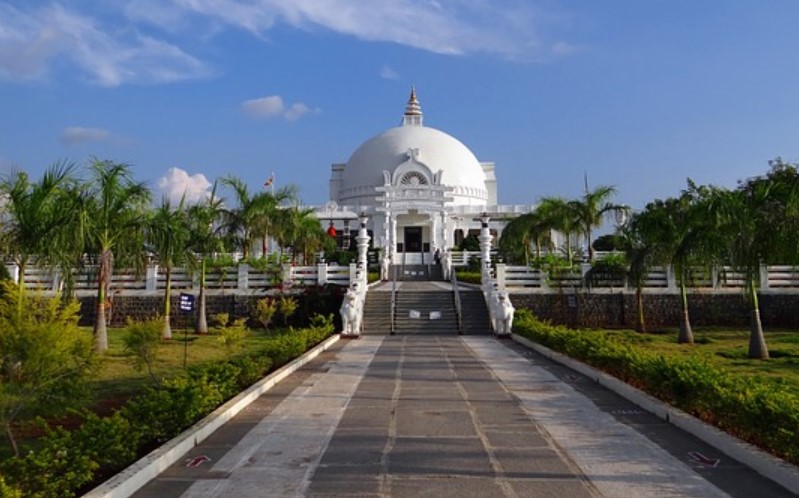
Nestled on the outskirts of Kalaburagi (formerly known as Gulbarga) in northern Karnataka, the Buddha Vihar stands as one of the most awe-inspiring spiritual destinations in South India. Whether you are a Buddhist devotee, a history enthusiast, or simply a curious traveller, this Buddha Vihar, Gulbarga offers an experience that blends deep spirituality, breathtaking architecture, and centuries of Buddhist legacy. If you are planning a visit or simply want to learn more about this remarkable landmark, this guide covers everything you need to know.
History of Buddha Vihar, Gulbarga
To understand the significance of the Buddha Vihar, Gulbarga one must first appreciate the deep-rooted Buddhist heritage of the Gulbarga region itself. Throughout history, Gulbarga has held importance as a place of ancient Buddhist learning. Sannathi, located within the district, was once a prominent Buddhist centre of pilgrimage during the Mauryan era, comparable in stature to Amaravati and Sanchi. Emperor Ashoka is said to have dispatched his son Mahendra and daughter Sanghamitra as emissaries to spread the teachings of Buddhism in this very region.
Against this rich historical backdrop, the idea of a grand modern vihara in Gulbarga was born. Construction began in 2002, initially conceived as a relatively modest structure. However, the Siddartha Vihar Trust, which spearheaded the project, revised the blueprints to transform it into a sprawling, world-class complex.
The Buddha Vihar, Gulbarga was formally inaugurated on 7 January 2007.
The complex was formally opened by none other than His Holiness the Dalai Lama, lending it immense spiritual authority. Built at a cost of over ₹8 crore, it is regarded as one of the largest Buddhist viharas in all of South India.
Beyond its religious purpose, the Vihara was conceived as a tribute to three of India’s greatest social reformers — Gautama Buddha, Basaveshwara, and Dr B.R. Ambedkar — who each dedicated their lives to the upliftment of the marginalised. The complex also functions as an active centre for creativity and research, with ongoing scholarly work focused on Buddhist philosophy and history.
A gold-plated smiling idol of Lord Buddha, accompanied by his two favourite disciples Ananda and Kashyap, was brought from Bangkok and installed here in 2004, further elevating the Vihara’s spiritual significance.
Architecture of Buddha Vihar, Gulbarga
The architecture of the Buddha Vihar, Gulbarga is undoubtedly its most striking feature. The complex masterfully blends architectural influences from eminent Buddhist centres including Sanchi, Sarnath, Ajanta, and Nagpur, while remaining faithful to the principles of traditional Buddhist architecture.
The main structure stands on approximately 33,000 square feet of land, supported by 170 pillars and 284 intricately carved blocks. The central dome soars to a height of 70 feet with a diameter of 59 feet, and is clad in marble, giving it a grand and luminous appearance.
Many visitors note that the imposing domed silhouette evokes memories of the Taj Mahal — though the Vihara distinguishes itself through its RCC construction finished with Italian white marble chips rather than the solid white marble of its Mughal counterpart.
The entrance to the complex is framed by four large Mahadwaras, fashioned in the style of the Sanchi gates, and a beautifully landscaped garden stretches all the way from the main gateway to the temple entrance. The white arch at the entrance is shaped like a peepal leaf — the sacred Bodhi tree — symbolising enlightenment.
Four towering Ashoka pillars, each standing 48 feet tall, mark the corners of the main building. These pillars are not merely decorative; each one symbolises one of the Four Noble Truths of Buddhism — the truth of suffering, the origin of suffering, the cessation of suffering, and the path leading to its cessation.
Inside the shrine, two finely crafted statues of Lord Buddha grace the ground and first floors. Among them is a striking six-foot idol carved from black stone, the work of renowned sculptor Ashoka Gudikara. The panchaloha (five-metal alloy) idol with a gold coating is considered the largest of its kind in South India.
The craftsmanship extends to the finest details: the entrance doors are fashioned from rosewood and teakwood, intricately carved by artisan Kaiser Ali, who has connections to the royal family of Mysore.
The broader complex includes a U-shaped Dhamma wing housing a dormitory, library, study centre, kitchen, dining hall, conference hall, exhibition hall, and guest rooms. An open-air theatre with a seating capacity of 2,500 adds to the Vihara’s role as a cultural hub. A group of eleven cement statues, led by a bronze figure of Dr B.R. Ambedkar, commemorates the historic Dhamma Kranti Yatra of 1956.
The Dhyana Mandir, or meditation hall, is one of the most visited spaces within the complex. Visitors are invited to sit in stillness and listen to the gentle chanting of the mantra Buddham Sharanam Gacchami while gazing at the serene, smiling face of the Buddha — an experience many describe as deeply transformative.
The construction consumed nearly 1,500 tonnes of cement, 250 tonnes of steel, 5 lakh bricks, and 200 cubic metres of sand, all shaped by the skilled hands of artisans and craftsmen.
Timings of Buddha Vihar, Gulbarga
The Buddha Vihar, Gulbarga welcomes visitors on all days of the week. The complex is open from 9:00 AM to 1:30 PM in the morning session and from 3:00 PM to 6:00 PM in the evening session.
The midday closure allows for maintenance and quiet observance within the shrine. Visitors are advised to plan their arrival accordingly and to dress modestly, as this is an active place of worship and meditation. Entry to the complex is generally free, making it accessible to all.
The best time to visit Gulbarga is between October and March, when the weather is pleasant and conducive to exploring outdoor attractions.
Location of Buddha Vihar, Gulbarga
The Buddha Vihar is located approximately six kilometres from Gulbarga city centre, along Sedam Road. The complex is situated adjacent to the Gulbarga University campus, making it easy to combine a visit with the university’s botanical garden or other nearby attractions.
How to Reach Buddha Vihar, Gulbarga
- By Road: Gulbarga is well connected to major cities via National and State Highways. Local auto-rickshaws, cabs, and city buses can take you directly to the Vihara from the city centre.
- By Rail: Kalaburagi Railway Station is approximately two kilometres from the city’s main landmarks and from there you can hire a cab or take an auto-rickshaw to the Vihara.
- By Air: The nearest major airport is in Hyderabad, roughly 235 kilometres away. Visitors flying in can take a bus or hire a vehicle to reach Gulbarga.
While in the area, consider also visiting the historic Gulbarga Fort, the Khwaja Banda Nawaz Dargah, and the ancient Sharanabasaveshwara Temple to make the most of your trip to this historically rich city.
Also read