
The Challakere Science City in Chitradurga district, Karnataka, is one of India’s most ambitious scientific projects. On a sprawling 8,000-acre expanse of semi-arid land, four of the country’s most powerful research and defence institutions — IISc, ISRO, DRDO, and BARC — have come together to build what could become a world-class science and technology township. Here is everything you need to know about how it came to be, what has been built, and what lies ahead.
How Did the Challakere Science City Come About?
The story begins in 2008, during the centenary celebrations of the Indian Institute of Science (IISc) in Bengaluru. Then Chief Minister B.S. Yediyurappa announced that the Karnataka government would provide land to IISc for a second campus. The site chosen was Challakere, a town in Chitradurga district, about 220 km from Bengaluru.
The choice made sense. Challakere offered vast, contiguous stretches of government land — the kind of space simply unavailable near a congested city like Bengaluru. Seeing the potential of the location, the government extended the opportunity to three other national institutions: ISRO, DRDO, and BARC. Together, the four institutions were allotted land covering approximately 8,000 acres, creating the foundation for what is now known as the Challakere Science City.
Which Institutions Are Part of the Challakere Science City?
Each of the four institutions has a distinct mandate at Challakere, and together they cover the full spectrum of India’s strategic and scientific priorities.
| Institution | Area Allotted | Key Focus at Challakere |
|---|---|---|
| IISc | 1,500 acres | Second campus with research in solar energy, climate science, skill development, and teacher training |
| ISRO | 473 acres | Remote sensing and communication facilities; Chandrayaan-2 tests were reportedly conducted here |
| DRDO | 4,290 acres | Aeronautical Test Range (ATR) for UAV testing; airstrip for unmanned and small manned aircraft |
| BARC | 1,810 acres | Nuclear material enrichment facility — second major nuclear centre in Karnataka after Kaiga |
What Has Actually Been Built So Far?
The Challakere Science City is not a failed proposal — real infrastructure has gone up on the ground. Progress has been slower than originally envisioned, partly due to environmental and legal hurdles, but the project is very much alive and operational in several areas.
IISc Challakere Campus
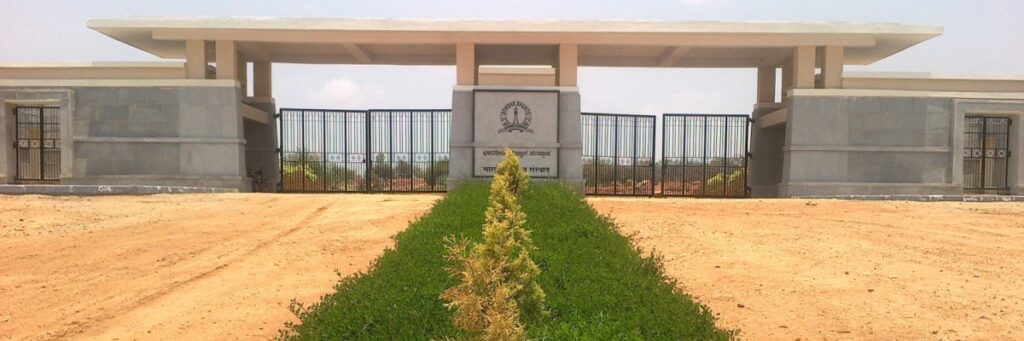
IISc’s second campus, officially known as the Challakere Campus (set up in Kudapura village), is the most visible and active part of the science city. A boundary wall, a peripheral road, and a main gate have been built. Two check dams have been constructed for rainwater harvesting, creating two substantial water bodies on campus. A drinking water pipeline from the Vani Vilas Sagar dam has been extended to the IISc, BARC, and DRDO campuses. A Solar Power Research Centre and a Climate Observatory are both functional, with research papers already published from these facilities.
The Talent Development Centre (TDC) was launched in February 2011 as a residential training centre for science and mathematics teachers from government schools in the region. In August 2020, Defence Minister Rajnath Singh inaugurated the HAL-IISc Skill Development Centre (SDC), a joint initiative with Hindustan Aeronautics Limited, aimed at training personnel in advanced manufacturing and aerospace skills. The Ministry of Education has also recognised the campus as a Centre of Excellence in Science and Mathematics Education under the national PMMMNMTT mission.
DRDO Aeronautical Test Range
DRDO’s facility at Challakere houses India’s Aeronautical Test Range (ATR), used for building and testing unmanned aerial vehicles (UAVs). The ATR includes an airstrip capable of supporting UAV operations and potentially small manned aircraft — a strategically critical facility for India’s defence self-reliance programme.
ISRO and BARC Facilities
ISRO’s facility focuses on remote sensing and communication, comparable in scope to the National Remote Sensing Centre in Hyderabad. BARC is developing a material enrichment facility for minerals like uranium and thorium used to fuel nuclear plants — making Challakere the second significant nuclear centre in Karnataka after Kaiga.
What About the Proposed Synchrotron?
One of the most talked-about proposals for Challakere was IISc’s plan to build a Synchrotron — a large circular magnetic facility similar in concept to CERN in Geneva, though focused on materials science and biology. The facility was expected to aid drug discovery, cancer therapy research, and medical imaging, operating in the 2.5 to 6 giga electron volt range.
As of 2025, the Synchrotron has not been built at Challakere. This remains one of the key unfinished promises of the science city, and no confirmed construction timeline has been publicly announced.
The Environmental Controversy
The development of the Challakere Science City has not been without opposition. The land allotted covers a significant portion of the Amrit Mahal Kaval — one of Karnataka’s largest remaining stretches of semi-arid grassland, historically maintained as grazing commons for the local pastoral community.
In 2013, the National Green Tribunal (NGT) issued a status quo order on all project activities in the Amrit Mahal Kaval grasslands, following petitions that argued the institutions had begun construction in ecologically sensitive areas without proper environmental clearances. This legal challenge caused considerable delays, and the debate around balancing national scientific interests against grassland conservation continues.
What Is the Current Status of Challakere Science City?
Challakere today is informally referred to as Karnataka’s “Science City” — a recognition that has moved from aspiration to partial reality. The IISc campus is the most active, with ongoing research, teacher training, and skill development programmes running. DRDO’s ATR is operational. ISRO and BARC facilities are present on the ground.
The grander vision — a fully integrated township with residential quarters for scientists, a synchrotron, and a complete science ecosystem — remains a work in progress. But describing Challakere as a failure would be inaccurate. It is a slow-moving, long-horizon project that has delivered real outcomes, with more expected in the decades ahead.
Frequently Asked Questions
Where is Challakere Science City located?
Challakere Science City is located in Challakere taluk of Chitradurga district in Karnataka, approximately 220 km from Bengaluru. The institutions are spread across around 8,000 acres near Kudapura village.
Which institutions are part of Challakere Science City?
Four major national institutions are part of the Challakere Science City: the Indian Institute of Science (IISc), the Indian Space Research Organisation (ISRO), the Defence Research and Development Organisation (DRDO), and the Bhabha Atomic Research Centre (BARC).
Has the Challakere Science City project been completed?
No, the Challakere Science City is not fully complete. While significant infrastructure has been built — including IISc’s active campus, DRDO’s Aeronautical Test Range, and facilities by ISRO and BARC — the full vision of an integrated township with a synchrotron and residential quarters is still a work in progress.
What is the IISc Challakere Campus known for?
The IISc Challakere Campus is known for its Talent Development Centre (TDC) for teacher training, a Solar Power Research Centre, a Climate Observatory, and the HAL-IISc Skill Development Centre inaugurated in 2020. It is also recognised by the Ministry of Education as a Centre of Excellence in Science and Mathematics Education.
What is DRDO doing at Challakere?
DRDO operates its Aeronautical Test Range (ATR) at Challakere, used to build and test unmanned aerial vehicles (UAVs) and drones. The facility includes an airstrip to support flight testing operations.
Why was there an NGT order against the Challakere project?
In 2013, the National Green Tribunal (NGT) issued a status quo order on construction activities at Challakere after environmental groups raised concerns that the project was encroaching on the Amrit Mahal Kaval grasslands — ecologically sensitive government commons — without adequate environmental clearances.
Will a synchrotron be built at Challakere?
IISc had proposed building a synchrotron facility at Challakere at an estimated cost of ₹2,000 crore, to support research in drug discovery, cancer therapy, and materials science. However, as of 2025, the synchrotron has not been built and no confirmed construction timeline has been publicly announced.
How far is Challakere from Bengaluru?
Challakere is approximately 200–225 km from Bengaluru and takes around 4 hours by road. It is connected to Bengaluru, Chitradurga, and Ballari by road, and has a railway station (Station Code: CHKE) on the Chikjajur–Ballari line.
Related Readings