
Nestled deep within the verdant Swamimalai forest range of Bellary district, Krauncha Giri in Karnataka stands as one of the most spiritually significant and historically rich pilgrimage destinations in South India. Home to the revered Kumaraswami Temple, this ancient hill is believed to be the very first earthly abode of Lord Karthikeya (Subramanya/Murugan) in all of South India. With its distinctive elliptical shape, mythological grandeur, and stunning natural surroundings, Krauncha Giri offers devotees and history enthusiasts an experience that is truly unparalleled.
History of Krauncha Giri in Karnataka
The history of Krauncha Giri in Karnataka stretches back well over a millennium, making it one of the most ancient sacred sites in the Deccan region. The temple complex on this hill was originally constructed by the Badami Chalukyas, placing its origins in the 7th to 8th century AD. The Parvati Temple within the complex is widely attributed to this dynasty and is considered one of the earliest surviving examples of Badami Chalukya architecture in the region.
In the subsequent centuries, the Rashtrakuta rulers took up the mantle of temple patronage. The Kumaraswami Temple — now the more prominent of the two shrines — was consecrated and further developed during the Rashtrakuta period, approximately between the 8th and 10th centuries AD. This dynasty gave the temple its current form, enshrining Lord Subramanya as the presiding deity, a role the hill had been associated with since ancient mythological times.
Over time, however, the dense forests of the Swamimalai range swallowed the temple entirely. For several centuries, the sacred site remained hidden beneath thick foliage, known only through scripture and legend, and many came to regard Krauncha Giri as more mythical than real — akin to the legendary Mount Meru. It was only in the 15th century that the Ghorpade dynasty, the local rulers of Sandur and a sub-clan of the Maratha Bhosale clan, rediscovered the temple deep within the forested Swamimalai hill. The Ghorpades ensured its restoration and threw open its doors for worship once again.
The Ghorpades left a progressive mark on the temple’s social history as well. As early as the 1930s, they declared the temple open to Harijans — a move so remarkable that Mahatma Gandhi, upon visiting Sandur, reportedly remarked: “A small state in South India has opened the temple to the Harijans; the heavens have not fallen.” Women, however, were restricted from entering it for several more decades, until Murarirao Yeshwantrao Ghorpade finally lifted the ban in October 1996. Since then, thousands of women devotees have been able to offer their prayers at this ancient shrine.
Today, both the Kumaraswami Temple and the Parvati Temple within the complex are protected monuments under the Archaeological Survey of India (ASI), ensuring their preservation for generations to come.
Legend of Krauncha Giri in Karnataka
The mythology surrounding Krauncha Giri in Karnataka is as dramatic as it is deeply rooted in Hindu scripture. The most celebrated legend associated with this hill concerns Lord Kumaraswami — also known as Karthikeya, Subramanya, Skanda, or Murugan — the divine son of Lord Shiva and Goddess Parvati, and the Hindu god of war.
According to ancient texts, the demon Tharakasura and his armies had taken refuge inside the Krauncha mountain to evade defeat in battle. In his mission to vanquish the forces of evil, Lord Karthikeya hurled his mighty spear — the Vel — at the mountain, cleaving it apart to destroy the demons concealed within. This divine act split the hill, creating the distinctive narrow pass that runs diametrically through Krauncha Giri to this day. Following his victory, Lord Karthikeya is said to have chosen this very spot as his first sacred abode in South India, which is why the hill and its temple hold such extraordinary spiritual significance.
This legend is not confined to oral tradition alone — it is firmly recorded in two of Hinduism’s most revered scriptures. The Mahabharata (Salya Parva, verse 46) and the Skanda Purana (Asura Kandam) both document the story of Karthikeya’s battle at Krauncha mountain, lending the site both mythological and textual authority.
Adding a literary dimension to its sacred reputation, the great Sanskrit poet Kalidasa referenced Krauncha Giri in his celebrated lyric poem Megha Sandesha (Meghaduta), describing the dramatic cleft in the mountain — a testament to how widely known and revered this hill was in classical Indian literature and culture.
The legends of Krauncha Giri do not end with Karthikeya alone. The hill is also associated with the sages Agastya and Parasurama, both of whom are said to have visited or been connected to this sacred space. Additionally, Krauncha Giri shares mythological ties with the Srisailam Jyotirlinga in Andhra Pradesh, further expanding its significance within the broader tapestry of South Indian sacred geography.
About the Temple of Krauncha Giri
The temple complex at Krauncha Giri in Karnataka is a treasure trove of ancient art, architecture, and devotion. Situated on the south-western corner of the Krauncha hill, the complex is accessible by road from Sandur and is nestled within the breathtaking Swamimalai forest range.
The Kumaraswami Temple
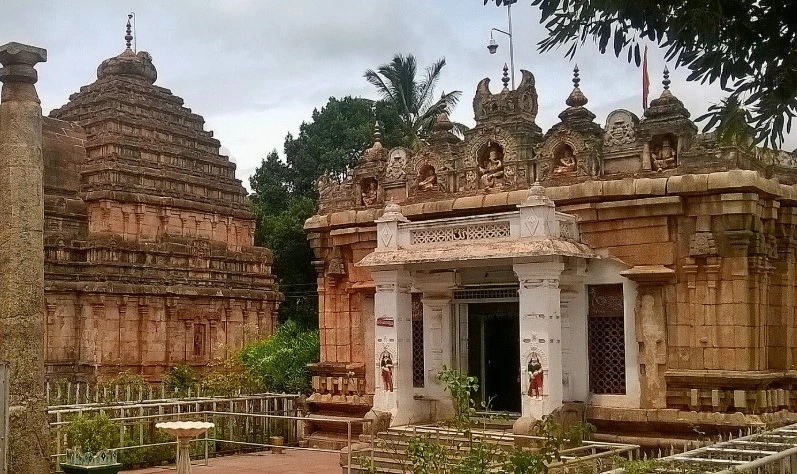
The Kumaraswami Temple is the spiritual heart of the complex. Built and consecrated by the Rashtrakuta dynasty between the 8th and 10th centuries AD, this temple enshrines Lord Kumaraswami (Karthikeya) as the presiding deity. The entrance of the sanctum is adorned with intricate engravings on soapstone, a hallmark of Deccan craftsmanship. The temple’s unique architectural feature is its unusual dome or shikhara — its composition is notably distinct from other temples across the country, with fascinating tiered structures atop the vimana. Interestingly, a vigraha of Lord Ganesha is also housed within the complex and has grown remarkably popular among devotees, sometimes even eclipsing the main deity in terms of daily veneration.
The Parvati Temple
The Parvati Temple stands beside the Kumaraswami Temple and is actually considered to be the older of the two shrines, attributed to the Badami Chalukyas of the 7th to 8th century AD. Art historians regard this temple as particularly remarkable for its architectural features. It belongs to what scholars describe as the “middle phase” of Badami Chalukya architecture — referred to by some as the Vesara style, and by scholar Adam Hardy as “Karnataka Dravida,” a Deccan variant of Dravidian architecture distinct from the styles that evolved in Tamil Nadu. One of its most notable features is that the temple has no mandapa (pillared hall), but instead possesses a long antarala (vestibule), above which is what Adam Hardy identifies as “possibly the first use of a sukanasa in a Dravida temple” — making it a landmark in the study of Indian temple architecture. The main deity here is Goddess Parvati.
The Natural Setting
The temple’s surroundings are as captivating as the structure itself. The Swamimalai forest range teems with wildlife — peacocks, leopards, spectacled cobras, Russell’s vipers, and a rich variety of flora including rosewood, sandalwood, and teak trees. Geologists note that Krauncha Giri was formed by ancient volcanic activity and is exceptionally rich in mineral deposits, including iron ore and manganese, which give the soil and lake in the area a characteristic red, marshy hue. The Karnataka State Highway 40 (SH-40) passes through the very gap in the mountain created, according to legend, by Lord Karthikeya’s spear — adding a compelling mythological layer to an everyday roadway.
Krauncha Giri Temple Timings
The temple is open daily from 9:30 AM to 1:30 PM and from 4:30 PM to 7:30 PM. Devotees are advised to dress modestly and observe temple decorum.
How to Reach Krauncha Giri
Reaching Krauncha Giri in Karnataka is convenient from several major transport hubs in the region, as it is located just 10 km from the town of Sandur in Bellary (Ballari) district.
By Road
Sandur lies directly on Karnataka State Highway 40, making it well-connected to the rest of the state by road. From Sandur, Krauncha Giri can be reached by local transport or by private vehicle. The road condition is generally reasonable, though travellers should exercise caution as heavy vehicles from mining operations frequently use the route.
By Rail
The nearest railway stations are Hospet Junction and Bellary (Ballari) Junction, both situated on the Guntakal–Hubballi rail line. From either station, visitors can hire taxis or board buses to Sandur, and then proceed to the temple.
By Air
The nearest airport is Bellary Airport. For those travelling from farther afield, Hubli Airport and Kempegowda International Airport in Bengaluru also offer connectivity, with onward travel by train or road to Bellary and Sandur.
From Bengaluru
Krauncha Giri is approximately 320–330 km from Bengaluru. The most convenient route is via NH 150A or NH 67, passing through Chitradurga and Hosapete. Buses operated by KSRTC connect Bengaluru to Hospet, from where local transport to Sandur is available.
A Timeless Destination
Krauncha Giri in Karnataka is far more than a place of worship — it is a living confluence of mythology, history, and natural splendour. From the battlefield of Karthikeya and Tharakasura to the architectural mastery of the Chalukyas and Rashtrakutas, every aspect of this sacred hill tells a story that spans millennia. Whether you are a devout pilgrim seeking the blessings of Lord Kumaraswami, a history enthusiast drawn to its ancient temples, or a nature lover captivated by the Swamimalai forest, Krauncha Giri promises an experience that will stay with you long after you leave.
Plan your visit to Krauncha Giri in Karnataka and discover one of South India’s most ancient, magnificent, and spiritually charged destinations.