The Mysore Ambari is the golden howdah that carries the idol of Goddess Chamundeshwari through the streets of Mysuru (Mysore) on Vijayadashami, the last day of Mysore Dasara. In Kannada, it is often called the Chinnada Ambari (golden howdah), and it is the centrepiece of the Jamboo Savari (elephant procession) that closes the Nada Habba (state festival).
This guide explains what the howdah is, how it passed from the Maharajas to the goddess, what it is made of, and which elephants have carried it, including the 2026 change when Abhimanyu stepped down after six years.
Key Takeaways
- The Mysore Ambari, or Chinnada Ambari (golden howdah), is a carved wooden howdah sheathed in gold that weighs about 750 kg in all.
- It carries the idol of Goddess Chamundeshwari in the Jamboo Savari on Vijayadashami, which falls on Wednesday, 21 October 2026.
- The Maharajas of Mysore once rode in it; since the 1970s the goddess has taken the king’s place.
- Abhimanyu carried the howdah at six Dasaras, from 2020 to 2025, and retired from howdah duty at 60 in 2026.
- As of 12 October 2026 the Forest Department had not named the 2026 howdah elephant; reports name Dhananjaya of the Dubare camp as the frontrunner.
- The procession runs about 5 km from Mysore Palace to Bannimantap.
Table of Contents
What is the Mysore Ambari?
An ambari is a howdah, the seat fixed on an elephant’s back. The Mysore Ambari is a wooden howdah covered in gold sheet and mounted on the lead elephant of the Jamboo Savari. The idol of Goddess Chamundeshwari sits in it; her temple stands on Chamundi Hills, and devotees regard her as the city’s protector. Read more about the Chamundeshwari Temple, Mysore.
On the afternoon of Vijayadashami, the Chief Minister and other dignitaries offer the goddess seated in the howdah at Mysore Palace a pushparchane (floral tribute). The howdah elephant then leads the procession out of the Palace towards Bannimantap, where, according to tradition, the banni (shami) tree is worshipped.

History of the Mysore Ambari: from Maharaja to goddess
The Wodeyar kings of Mysore rode in the golden howdah at the head of the Dasara procession, accepting offerings from the crowds along the way. The date the howdah was made is not recorded. It is generally described as a nineteenth-century piece, and its gold work is credited to a goldsmith named Singannacharya.
By most accounts, Jayachamarajendra Wadiyar, the last ruling Maharaja, was the last member of the royal family to ride in the Mysore Ambari. In the 1970s the Government of Karnataka took charge of the festival as the Nada Habba, and the idol of Goddess Chamundeshwari took the king’s place in the howdah. The royal family still keeps its private Navaratri rituals inside the Palace. The wider story is told in our history of Mysore Dasara.

Design and weight of the Mysore Ambari
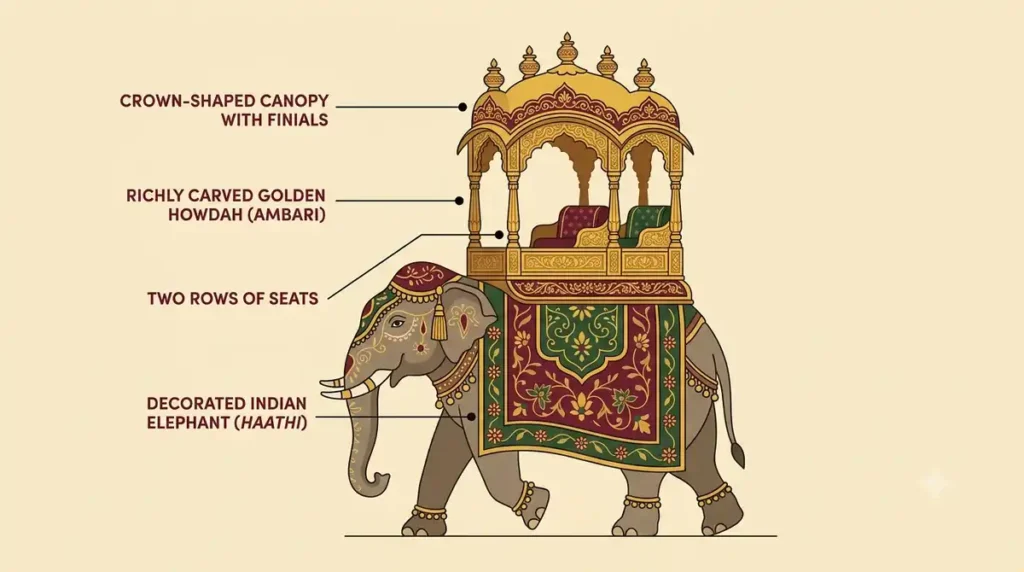
The Mysore Ambari weighs about 750 kg in all. Its frame is carved wood sheathed in gold sheet; most accounts put the gold at about 80 kg, though figures between 80 kg and 85 kg appear in different sources. The goddess sits on a silver seat.
Descriptions of the howdah mention two rows of wide seats, meant originally for the Maharaja and members of the royal family; three carved pillars on each of its four sides; a crown-shaped canopy; and five kalashas (ornamental finials) on top.
The weight explains why the howdah elephant is chosen so carefully. With the thick padding laid beneath the howdah, the elephant must carry a heavy, high load steadily through about 5 km of packed streets, past bands, drums and cheering crowds.
Where is the Mysore Ambari kept?
Outside Dasara, the howdah stays in the care of Mysore Palace. Visitors to the Palace can see an ornate, gold-decorated elephant howdah in the Gombe Thotti (dolls’ pavilion), one of the sights on a Palace visit.
Who carries the Mysore Ambari in 2026?
For the first time since 2020, a new elephant will carry the Mysore Ambari. Abhimanyu, a tusker from the Mathigodu Elephant Camp in Nagarahole, carried it at six consecutive Dasaras, from 2020 to 2025. He turned 60 in 2026, the age at which Forest Department norms bar heavy work, and was given a ceremonial farewell at Veeranahosahalli on 26 August 2026, the day the Gajapayana (the elephants’ march to Mysuru) began.
As of 12 October 2026, the Forest Department had not announced the 2026 howdah elephant. Five tuskers were trained to carry weight this season: Dhananjaya, Mahendra, Ekalavya, Prashantha and Sugreeva. News reports name Dhananjaya, a 45-year-old tusker from the Dubare Elephant Camp who was the nishane (flag-bearing) elephant in 2025, as the frontrunner. The final choice rests with the Forest Department.
Reports in September 2026 also said Abhimanyu may return to the procession this year as the nishane elephant, though he will not carry the howdah. Meet the full squad in our guide to the elephants of Mysore Dasara 2026.
Elephants that have carried the Mysore Ambari
Only a handful of elephants have carried the howdah in the past three decades. Each served for years, and the role usually passes to an elephant that has already walked in the procession in a supporting role.
Table 1 – Elephants that have carried the Mysore Ambari
| Elephant | Years as howdah elephant | Dasaras | Notes |
|---|---|---|---|
| Drona | Until 1998 | Not officially recorded | Died in 1998 |
| Balarama | 1999 – 2011 | 13 | Succeeded Drona |
| Arjuna | 2012 – 2019 | 8 | Stepped down at 60; died in December 2023 |
| Abhimanyu | 2020 – 2025 | 6 | Retired from howdah duty at 60 in 2026 |
| To be confirmed | 2026 | – | Dhananjaya reported as frontrunner |
| Source: Mysuru Dasara Committee (mysoredasara.gov.in) and news reports, as of October 2026. Years before 1999 are not officially documented. | |||
Arjuna’s story is told in The Tale of Arjuna – The Star Elephant of Dasara. He died on 4 December 2023, injured in a fight with a wild tusker during an operation to capture wild elephants in Hassan district.
How the Mysore Ambari elephant is chosen and trained
The Dasara elephants travel from forest camps such as Dubare, Mathigodu and Balle to Mysuru in the Gajapayana, which in 2026 was flagged off on 26 August. At the Palace, the trainee howdah elephants practise carrying weight for weeks before the real howdah is placed on one of them. Rehearsals typically use a wooden howdah of similar size loaded with sandbags, and the elephants walk the route to grow used to crowds, music and noise.
Forest officials judge candidates on strength, steadiness, gait and temperament. On Vijayadashami, female kumki (trained) elephants walk beside the howdah elephant to keep it calm in the crowd.
Seeing the Mysore Ambari at Jamboo Savari 2026
Mysore Dasara 2026 runs from Sunday, 11 October to Wednesday, 21 October. The Mysore Ambari comes out on Vijayadashami, Wednesday, 21 October 2026. The pushparchane to the goddess in the golden howdah is scheduled between 4:10 PM and 4:35 PM, after which the procession leaves the Palace (as of October 2026, per the official Mysuru Dasara website).
The route covers about 5 km from Mysore Palace to Bannimantap. Seats inside the Palace and at Bannimantap need a Dasara Gold Card or a procession ticket; the route itself can be watched from the roadside, though crowds build hours ahead. Timings, tickets and road closures are in our Mysore Dasara dates and schedule, and the route is described in our Mysore Dasara parade guide.
Mysuru is about 140 km from Bengaluru (Bangalore). Mysuru Junction railway station is about 2 km from Mysore Palace, Mysuru Airport at Mandakalli is about 10–12 km from the city, and Kempegowda International Airport, Bengaluru, is about 170 km away. While in the city, a morning trip to Chamundi Hills completes the story of the goddess who rides in the howdah.
FAQ: Mysore Ambari
How heavy is the Mysore Ambari?
About 750 kg in all. It is a carved wooden howdah covered in gold sheet, generally put at about 80 kg of gold.
Who carries the Mysore Ambari in 2026?
As of 12 October 2026, the Forest Department had not named the 2026 howdah elephant. News reports name Dhananjaya of the Dubare camp as the frontrunner among five trained tuskers.
Why is Abhimanyu not carrying the howdah in 2026?
Abhimanyu turned 60 in 2026, the age at which Forest Department norms bar heavy work such as carrying the howdah. He carried it at six Dasaras, from 2020 to 2025.
Who rode in the golden howdah before the goddess?
The Maharajas of Mysore. Since the 1970s, when the State Government took charge of Mysore Dasara, the idol of Goddess Chamundeshwari has ridden in the howdah instead.
When can I see the Mysore Ambari in 2026?
On Vijayadashami, Wednesday, 21 October 2026. The floral tribute at Mysore Palace is scheduled for 4:10 PM to 4:35 PM, and the Jamboo Savari leaves the Palace after it.
How long is the Jamboo Savari route?
About 5 km, from Mysore Palace to Bannimantap.
Also read