Mahalakshmi is the goddess of wealth, auspiciousness and prosperity. She is worshipped for healthy progeny and for the husband’s health and long life. The vratha is observed on a Friday that falls before the full moon day of Shravana masa (August–September), and in Karnataka it is among the most widely kept household vows of the year.
Vara Mahalakshmi 2026 date
In Karnataka, Vara Mahalakshmi Vratha falls on Friday, 21 August 2026. Shravana Purnima itself falls a week later, on Friday, 28 August 2026.
Why some calendars say 28 August
The Purnima tithi of Shravana begins at 9:08 am on Thursday, 27 August 2026 and ends at 9:48 am on Friday, 28 August. By the sunrise rule, the full moon day is therefore Friday the 28th — which means the Purnima day is itself a Friday, and the usual instruction, “the Friday before the full moon day”, points in two directions at once.
Kannada, Telugu and Tamil panchangas read it as the Friday clearly preceding the Purnima and place the vratha on 21 August; the Karnataka restricted-holiday list for 2026 follows the same reading. Several North-India-facing calendars apply it to the Friday on which the Purnima falls and list 28 August. Neither is an error — the same rule meets an unusual tithi alignment and yields two answers.
If your family or kula custom names a date, keep that one.
Puja muhurta for 21 August 2026
The puja is traditionally begun in a sthira lagna — a fixed-sign ascendant (Vrishabha, Simha, Vrischika, Kumbha) — so that Lakshmi, once invoked, stays. Simha lagna in the morning is the window most households use. Timings below are for Bengaluru; Mysuru and Hubballi run within a few minutes of these, Mangaluru about six minutes later.
| Window | Time (Bengaluru) | Note |
|---|---|---|
| Sunrise / sunset | 6:09 am / 6:36 pm | Shukla Dashami at sunrise; Jyeshtha nakshatra |
| Simha lagna | 5:52 – 7:55 am | The main window; most households finish before 7:43 am |
| Abhijit muhurta | 11:58 am – 12:47 pm | General-purpose auspicious window |
| Vrischika lagna | 12:07 – 2:19 pm | Effectively from 12:23 pm, once Rahu kaal ends |
| Kumbha lagna | 6:19 – 8:01 pm | For evening observance |
| Rahu kaal | 10:49 am – 12:23 pm | Avoid |
| Gulika kaal | 7:43 – 9:16 am | Avoid – it clips the tail of Simha lagna |
| Date | Friday, 21 August 2026 | |
| Location | Bengaluru, 12.97 N / 77.59 E | |
| Method | Swiss Ephemeris, Lahiri ayanamsa | For other towns, check your local panchanga |
How the vratha is performed
Early in the morning, after their bath, women draw a rangoli at the spot where the kalasha will be placed — usually a lotus of eight petals.
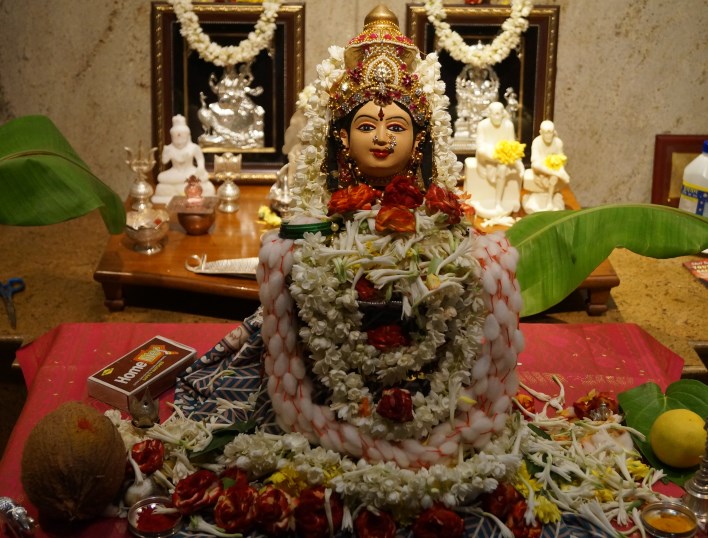
The sacred kalasha, of brass, copper or silver, is filled with rice and topped with fresh mango leaves, a coconut and a cloth. It is set on the mandala, and Lakshmi is invoked into it.
The kalasha is then decorated: flowers, jewellery, vastra — a new saree — fruit, dry fruit, fresh grain, sweets and savouries. Some place coins or currency notes at its foot, or string the notes into a garland. A silver or brass face of the goddess is often fixed to the pot.
The puja opens with worship of Lord Ganesha, after which the main worship of Varalakshmi begins.
The raksha — a turmeric-smeared thread of nine strands knotted nine times — is worshipped alongside the kalasha and then tied to the right wrist of the woman keeping the vratha. Articles are given in charity to sumangalis.
The eight forms of Lakshmi
Lord Narayana — Vishnu, Hari — the consort of Lakshmi and an embodiment of shuddha sattva, is the preserver of the world. He is also called Ashta Lakshmi Pati, lord of the eight Lakshmis:
- Adi Lakshmi — the primordial form, the protector
- Dhana Lakshmi — wealth
- Dhanya Lakshmi — grain and nourishment
- Vijaya Lakshmi — victory
- Vidya Lakshmi — knowledge
- Santana Lakshmi — progeny
- Dhairya Lakshmi — courage and strength
- Soubhagya Lakshmi — marital good fortune, the long life of the husband
Together, they embody an ideal woman. Some lists list Gaja Lakshmi instead of Soubhagya Lakshmi.
The story of Charumathi
The significance of the Varalakshmi vratha was narrated by Lord Shiva to Goddess Parvathi in the Skanda Purana. Those who keep it, he said, are blessed with dhana (wealth), dhanya (grain), ayu (long life), arogya (health), aishwarya (prosperity), santana (progeny) and soubhagya (the long life of the husband).
According to the legend, a pious woman named Charumathi lived in the town of Kundinyapura. She was respectful to her in-laws, loving towards her husband and children, and wholehearted in her worship of the goddess. One night Lakshmi came to her in a dream and asked her to perform this puja. With her family’s consent, Charumathi kept the vratha and told the other women of the town of it. Through the goddess’s blessing, she, her family and her friends were granted prosperity — and they in turn shared their good fortune with many more.
What is cooked
In South India, the festival brings obbattu, kosambari, puliyogare, huli anna and hesarubele payasa. In the evening, women visit one another’s houses to exchange sweets, tamboola and offerings.
Vara Mahalakshmi dates, 2026 to 2030
| Year | Vara Mahalakshmi Vratha | Shravana Purnima | Note |
|---|---|---|---|
| 2026 | Friday, 21 August | Friday, 28 August | Purnima falls on a Friday; some calendars list 28 August |
| 2027 | Friday, 13 August | Tuesday, 17 August | |
| 2028 | Friday, 4 August | Saturday, 5 August | |
| 2029 | Friday, 17 August | Friday, 24 August | Same ambiguity as 2026; confirm nearer the date |
| 2030 | Friday, 9 August | Tuesday, 13 August | |
| Method | Swiss Ephemeris / Lahiri ayanamsa, Bengaluru | Validated against observed dates for 2023, 2024, 2025 and 2027 | |
| Rule | The Friday preceding the Shravana Purnima day | Kannada / Telugu / Tamil reading |

In 2026 and again in 2029, Shravana Purnima falls on a Friday, so calendars differ by a week. The dates above follow the Kannada reading. Confirm against your panchanga in the weeks before the festival.
With the blessing of Lord Vishnu and Goddess Lakshmi, one finds peace and prosperity in one’s life.
4. FAQ block
When is Vara Mahalakshmi Vratha in 2026?
In Karnataka, it falls on Friday, 21 August 2026. Some calendars outside the state list 28 August; both readings are explained above.
Why do some calendars say 28 August 2026?
Shravana Purnima 2026 is itself a Friday. Panchangas that read the rule as “the Friday preceding the Purnima day” give 21 August; those that read it as “the Friday on which the Purnima falls” give 28 August.
What is the best time to do the puja?
Simha lagna, 5:52 to 7:55 am in Bengaluru, is the window most households use. Vrischika lagna in the early afternoon and Kumbha lagna in the evening are the alternatives. Avoid Rahu kaal, 10:49 am to 12:23 pm.
Can unmarried women keep the vratha?
It is traditionally kept by married women for the well-being of the household, but unmarried women and widows keep it in many families. Practice varies by community.
What do I need for the puja?
A kalasha of brass, copper or silver; rice; mango leaves; a coconut; a new cloth or saree; turmeric, kumkum and flowers; the nine-strand raksha thread; and the naivedya — usually obbattu, payasa and kosambari.
When is the raksha thread removed?
It is usually kept on the wrist until it falls away on its own, or until the next auspicious day named by family custom.
Also see,