
The Hasanamba Temple in Hassan is one of the most unusual temples in Karnataka: its sanctum opens to devotees for only about two weeks a year, around Deepavali, then seals again until the next year. Devotees believe the ghee lamp lit when the doors close is still burning when they reopen a year later, and that the flowers and rice offering left inside are still fresh.
In 2026 the Hasanamba Temple opened on Thursday, 29 October. Public darshan runs from 30 October to 10 November, and the doors close on 11 November. This guide covers the day-wise darshan timings, ticket options and online booking, the legends behind the temple, and how to reach Hassan.
Hasanamba (also spelt Hassanamba or Hassanaamba) is the presiding goddess of Hassan, and the town is widely said to take its name from her. Her annual jatre (temple fair), officially the Sri Hasanamba Devi Darshan and Sri Siddeshwara Swamy Jatra Mahotsava, is run by the Hassan district administration with the Hindu Religious and Charitable Endowments (Muzrai) Department. In 2024, more than 20 lakh devotees had darshan, and lakhs travel from across Karnataka and neighbouring states every year.
Key Takeaways
- The Hasanamba Temple in Hassan opens only once a year, for about two weeks around Deepavali.
- 2026: doors opened 29 October; public darshan 30 October – 10 November; doors close 11 November.
- Darshan is free in the general queue; special (Rs. 300) and VIP (Rs. 1,000) tickets can be booked online.
- Devotees believe the lamp lit when the doors close is still burning a year later, with the flowers and rice offering fresh.
- The temple is in the centre of Hassan, about 185 km from Bengaluru and 4 km from Hassan Junction railway station.
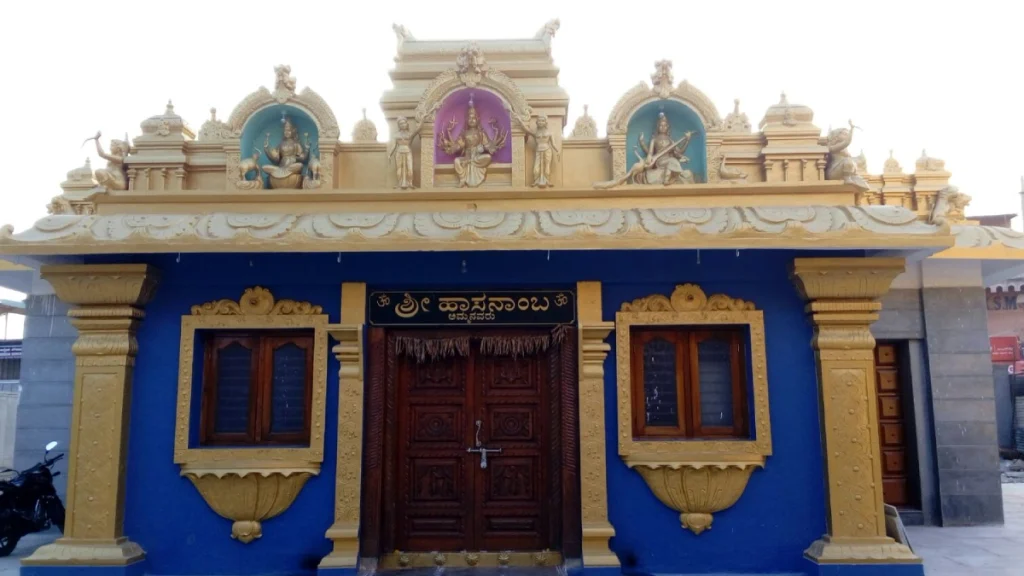
Table of Contents
Hasanamba Temple Opening Dates 2026
The doors of the Hasanamba Temple were opened at 12:00 noon on Thursday, 29 October 2026, after the customary rituals. There is no public darshan on the opening day or the closing day. According to the official temple website, public darshan runs from Friday, 30 October to Tuesday, 10 November 2026, and the doors close at noon on Wednesday, 11 November.
Darshan hours are not the same every day. On most days the queue is open from 6:00 AM to 2:00 PM and again from 3:30 PM until midnight or the early hours of the next morning. The gaps are for naivedya (the food offering to the goddess), when there is no public darshan. Check the exact hours for the day you plan to visit in the table below.
Hasanamba Temple Darshan Timings 2026 (Day-wise)
| Date | Darshan hours | No public darshan |
|---|---|---|
| 29 Oct 2026 (Thu) | Doors open at 12:00 noon | No public darshan all day |
| 30 Oct 2026 (Fri) | 6:00 AM – 7:00 PM | After 7:00 PM |
| 31 Oct 2026 (Sat) | 6:00 AM – 2:00 PM; 3:30 PM – 3:00 AM (next day) | 2:00 PM – 3:30 PM; 3:00 AM – 6:00 AM |
| 1 Nov 2026 (Sun) | 6:00 AM – 2:00 PM; 3:30 PM – 3:00 AM (next day) | 2:00 PM – 3:30 PM; 3:00 AM – 6:00 AM |
| 2 Nov 2026 (Mon) | 6:00 AM – 2:00 PM; 3:30 PM – 3:00 AM (next day) | 2:00 PM – 3:30 PM; 3:00 AM – 6:00 AM |
| 3 Nov 2026 (Tue) | 6:00 AM – 2:00 PM; 3:30 PM – 3:00 AM (next day) | 2:00 PM – 3:30 PM; 3:00 AM – 6:00 AM |
| 4 Nov 2026 (Wed) | 6:00 AM – 2:00 PM; 3:30 PM – 12:00 midnight | 2:00 PM – 3:30 PM; 12:00 midnight – 6:00 AM |
| 5 Nov 2026 (Thu) | 6:00 AM – 2:00 PM; 3:30 PM – 2:00 AM (next day) | 2:00 PM – 3:30 PM; 2:00 AM – 6:00 AM |
| 6 Nov 2026 (Fri) | 6:00 AM – 2:00 PM; 3:30 PM – 3:00 AM (next day) | 2:00 PM – 3:30 PM; 3:00 AM – 6:00 AM |
| 7 Nov 2026 (Sat) | 6:00 AM – 2:00 PM; 3:30 PM – 12:00 midnight | 2:00 PM – 3:30 PM; 12:00 midnight – 6:00 AM |
| 8 Nov 2026 (Sun) | 6:00 AM – 2:00 PM; 3:30 PM – 2:00 AM (next day) | 2:00 PM – 3:30 PM; 2:00 AM – 6:00 AM |
| 9 Nov 2026 (Mon) | 6:00 AM – 2:00 PM; 3:30 PM – 12:00 midnight | 2:00 PM – 3:30 PM; 12:00 midnight – 6:00 AM |
| 10 Nov 2026 (Tue) | 6:00 AM – 7:00 PM; 1:00 AM – 7:00 AM (night of 10-11 Nov) | 7:00 PM – 1:00 AM |
| 11 Nov 2026 (Wed) | Doors close at 12:00 noon | No public darshan |
| Source: Sri Hassanaamba Temple official website (srihassanaambatemple.com), day-wise darshan schedule for 2026, as of 3 November 2026. Gaps in darshan are for naivedya (food offering to the goddess). Times can change at short notice; check the official website or helpline before you travel. | ||
Hasanamba Temple Opening Dates in Recent Years
The dates move every year because they follow the Hindu lunar calendar, so the temple can open as early as the first week of October or as late as the end of the month.
| Year | Doors opened | Doors closed |
|---|---|---|
| 2024 | 24 October | 3 November |
| 2025 | 9 October | 23 October |
| 2026 | 29 October | 11 November |
| 2027 | To be announced | To be announced |
| Dates are the festival period, from the opening to the closing of the sanctum doors; there is no public darshan on the opening and closing days. Sources: Deccan Herald (2024, 2025); Sri Hassanaamba Temple official website (2026). As of November 2026. | ||
Hasanamba Temple Darshan Tickets and Online Booking
There are three queues at the Hasanamba Temple: the free dharma darshan (general) queue and two paid queues that move faster. On weekends and in the days just before Deepavali, the general queue can take several hours.
| Darshan type | Price | How to get it |
|---|---|---|
| Dharma darshan (general queue) | Free | No booking needed; join the general queue |
| Special darshan | Rs. 300 per person | Online (website, app or WhatsApp) or at ticket counters near the temple |
| VIP darshan | Rs. 1,000 per person | Online (website, app or WhatsApp) or at ticket counters near the temple |
| KSTDC/KSRTC one-day tour package | Package fare set by KSTDC/KSRTC; includes a Rs. 1,000 special darshan ticket | From Bengaluru or Mysuru, 30 October – 10 November 2026; book on kstdc.co or ksrtc.in |
| Sources: Sri Hassanaamba Temple official website and Karnataka Tourism, as of November 2026. | ||
Paid tickets can be booked in advance in three ways:
- The official website, srihassanaambatemple.com.
- The Sri Hassanaamba app, from Google Play or the App Store. If you installed last year’s app, update it before booking.
- The WhatsApp booking chatbot on +91 63661 05589.
Tickets are also sold at counters near the temple. The temple helpline numbers are 7353939613, 7353939614 and 7353939618. During the jatre, KSTDC and KSRTC run one-day tour packages from Bengaluru and Mysuru that include a special darshan ticket; details are on the Karnataka Tourism event page.
The Legend of the Lamp and the Food That Stays Fresh
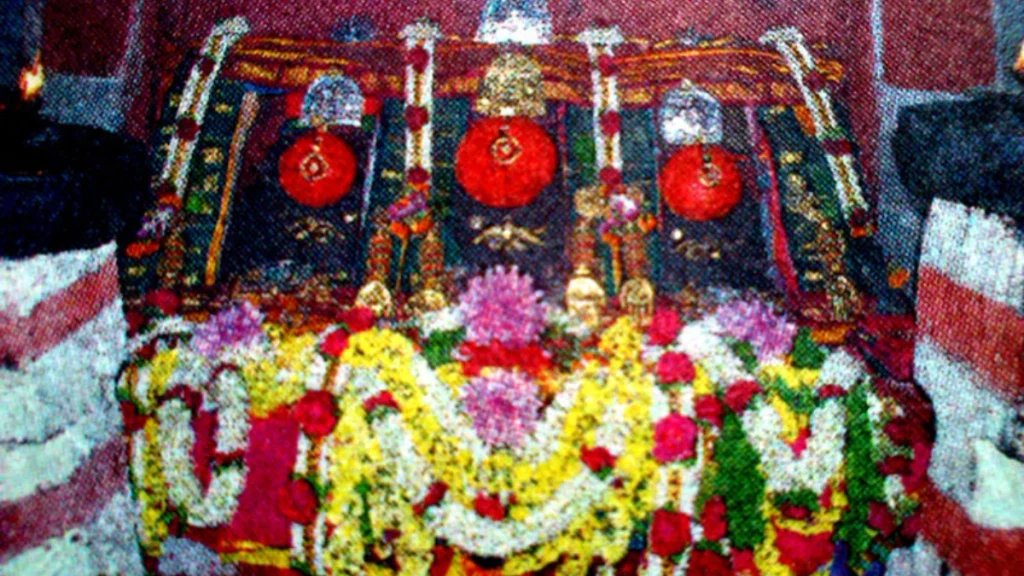
The best-known belief about the Hasanamba Temple concerns what happens while its doors are shut. When the sanctum is closed after Deepavali, the priests leave before the goddess a lighted ghee lamp, known as the Nanda Deepa, along with flowers, water and two bags of rice. According to local tradition, when the doors are opened a year later the lamp is still burning, the flowers have not wilted and the rice offering is fresh and unspoilt.
Every year, newspapers in Karnataka carry accounts from priests and officials present at the opening who describe finding the lamp alight and the flowers fresh. Devotees see this as a sign of the goddess’s power, and it is a large part of why such a short opening draws such large crowds.
A note on the legend: the lamp, flowers and offerings are described here as devotees and temple officials report them. The sanctum stays sealed through the year and the claim has not been independently examined.
How the Hasanamba Temple Doors Are Opened and Closed
By tradition, the doors of the Hasanamba Temple open on the Thursday after the full moon of the Hindu month of Ashwayuja (Ashvija) and are sealed a day after Bali Padyami, the last day of Deepavali. This is why the dates shift from year to year.
The opening is a public ceremony. After the priests complete the rituals, a member of the Arasu family cuts a plantain (banana) stem, as custom requires, and the district administration opens the sanctum in the presence of priests, officials and the media. The closing follows a similar set of rituals, and the doors then stay shut until the next jatre.
History and Mythology of the Hasanamba Temple
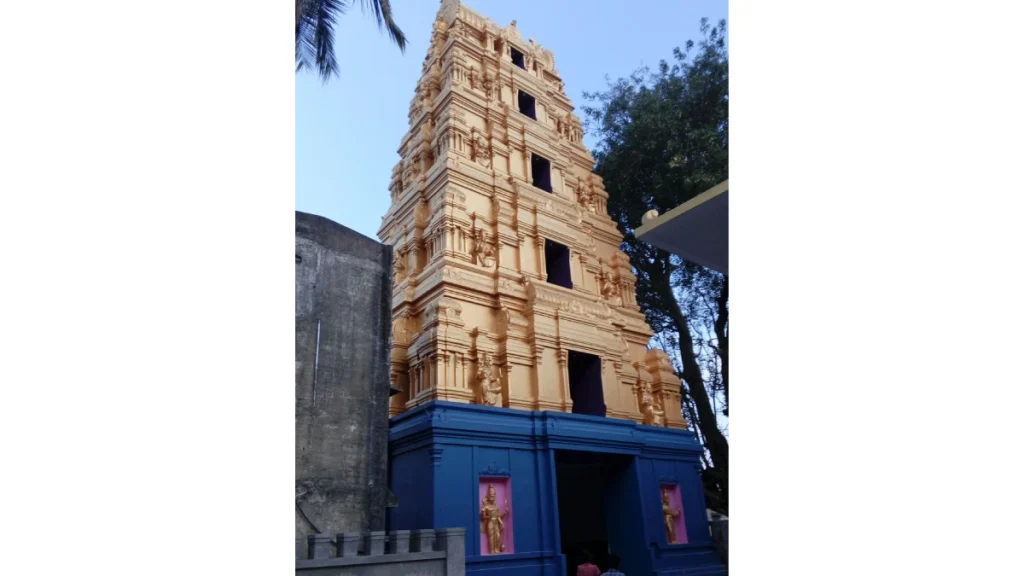
The Hasanamba Temple is believed to date to the 12th century, though who built it is not recorded with certainty. The goddess is worshipped as a form of Shakti, and her name is usually explained as “the smiling mother”, from hasya, a smile.
The Seven Mothers (Sapta Matrikas)
According to legend, the seven Matrikas (Sapta Matrikas, the seven mother goddesses) – Brahmi, Maheshwari, Kaumari, Vaishnavi, Varahi, Indrani and Chamundi – travelled south from Varanasi and were so taken by the beauty of Hassan that they chose to stay. Maheshwari, Kaumari and Vaishnavi took the form of three anthills inside the temple; Indrani, Varahi and Chamundi settled in three wells at Devigere Honda, a tank nearby; and Brahmi went to Kenchammana Hosakote in Alur taluk. Some tellings place Chamundi, rather than Brahmi, at Kenchammana Hosakote.

How Hassan Got Its Name
Hassan is widely said to be named after the goddess Hasanamba. Another local tradition links the name to Simhasanapuri, a place associated with King Janamejaya, the great-grandson of Arjuna in the Mahabharata.
Other Legends: Sose Kallu and Kallappana Gudi
Inside the temple is a stone called Sose Kallu, “the daughter-in-law’s stone”, linked to a story of a devotee who was ill-treated by her mother-in-law. Accounts differ on whose stone it is: in one telling the goddess turned the cruel mother-in-law to stone, in another she turned the devotee herself to stone to shield her. Devotees believe the stone moves a little closer to the goddess every year, and that when it reaches her feet the Kali Yuga will end.
Another legend tells of four thieves who tried to steal the goddess’s jewels and were turned to stone. The four stones can still be seen at the Kallappana Gudi, “the thieves’ shrine”.
What to See at the Hasanamba Temple
An anthill inside the temple represents the presiding deity. One of the most talked-about carvings in the Hasanamba Temple shows Ravana, the demon king of the Ramayana, with nine heads instead of the usual ten, playing a veena. The complex also has a shrine to Siddeshwara Swamy, a form of Shiva, which is why the annual festival carries the names of both deities.
During the jatre the district administration also runs a programme of public events in Hassan, including a youth festival, a rangoli competition, livestock and flower shows, a folk fair, a cookery contest and a dog show. Hassan’s jatre is also listed in our month-by-month guide to the festivals of Karnataka.
Tips for Visiting the Hasanamba Temple
Weekends and the days just before Deepavali bring the heaviest crowds, so a weekday visit, early in the morning or late at night while the queue is open, usually means a shorter wait. If your time is short, a paid ticket booked in advance can save hours. Footwear is not allowed inside the temple and a dress code applies; the official website has the details.
For security, the district administration does not allow the following into the darshan queue:
- Alcohol and intoxicants
- Tobacco, cigarettes and gutka
- Lighters, matches and other flammable items
- Firecrackers and explosives
- Knives, blades and other sharp objects, and weapons of any kind
- Plastic waste
- Large bags and bulky luggage
- Unauthorised cameras, drones and recorders
Hassan is busy throughout the jatre, with traffic diversions and designated parking areas, so plan for extra travel time and book a room early if you want to stay overnight.
How to Reach the Hasanamba Temple
The Hasanamba Temple is in the centre of Hassan town, so getting to Hassan is most of the journey.
By Road
Hassan lies on NH 75, the Bengaluru-Mangaluru highway. KSRTC runs frequent buses to Hassan from Bengaluru, Mysuru, Mangaluru and other cities, and the KSTDC and KSRTC one-day tour packages run from Bengaluru and Mysuru during the jatre.
Table 4 – Distance to Hasanamba Temple, Hassan by road
| From | Approximate distance to Hassan by road |
|---|---|
| Bengaluru (Bangalore) | About 185 km |
| Mysuru (Mysore) | About 115 km |
| Mangaluru (Mangalore) | About 172 km |
| Chikkamagaluru (Chikmagalur) | About 60 km |
| Belur | About 38 km |
| Shravanabelagola | About 51 km |
| Distances are approximate, to Hassan town centre, and vary by route. | |
By Rail
Hassan Junction (station code HAS) is about 4 km from the temple, with trains from Bengaluru, Mysuru, Mangaluru and other cities. Autorickshaws and taxis are available outside the station.
By Air
Hassan has no commercial airport. The nearest major airport is Kempegowda International Airport, Bengaluru, about 190-200 km away by road; travellers from the coast can also fly into Mangaluru International Airport.
Places to See Near the Hasanamba Temple
Hassan is the usual base for Karnataka’s Hoysala heritage trail. Belur, about 38 km away, the neighbouring temple town of Halebidu and the Jain pilgrimage town of Shravanabelagola can be covered together; see our Belur, Halebidu and Shravanabelagola circuit.
Closer to town, the Hoysala-era Lakshmi Devi Temple at Doddagaddavalli, the hilltop Sri Lakshmi Venkataramanaswamy Temple at Mavinakere and the Shettihalli Rosary Church, which is half-submerged by the Hemavathy backwaters in the monsoon, make good half-day trips. For more ideas, see our list of places to visit near Hassan and all our Hassan travel guides.
Frequently Asked Questions about the Hasanamba Temple
When does the Hasanamba Temple open in 2026?
The Hasanamba Temple opened at noon on 29 October 2026. Public darshan runs from 30 October to 10 November 2026, and the doors close at noon on 11 November. There is no public darshan on the opening and closing days.
What are the Hasanamba Temple darshan timings?
The hours change from day to day. On most days darshan runs from 6:00 AM to 2:00 PM and from 3:30 PM until midnight or the early hours of the next morning, with breaks for naivedya. Check the day-wise schedule on the official website, srihassanaambatemple.com, before you travel.
How much is the Hasanamba darshan ticket?
Darshan in the general queue is free. Special darshan costs Rs. 300 and VIP darshan Rs. 1,000 per person. Tickets can be booked on srihassanaambatemple.com, through the Sri Hassanaamba app or the WhatsApp chatbot on +91 63661 05589, or bought at counters near the temple.
Is it true that the lamp and food at Hasanamba Temple stay fresh for a year?
That is what devotees believe. When the doors close after Deepavali, a ghee lamp, flowers, water and two bags of rice are left before the goddess, and according to tradition the lamp is still burning and the offerings are fresh when the doors reopen a year later. The claim has not been independently examined.
Why do the Hasanamba Temple dates change every year?
By tradition, the doors open on the Thursday after the full moon of the month of Ashwayuja and close a day after Bali Padyami. Both follow the Hindu lunar calendar, so the dates shift each year.
When will the Hasanamba Temple open in 2027?
The 2027 dates have not been announced yet. The Hassan district administration usually announces the next year’s dates around the time the temple closes; this page will be updated once they are confirmed.
How far is the Hasanamba Temple from Bengaluru?
The Hasanamba Temple is in the centre of Hassan, about 185 km from Bengaluru by road on NH 75. KSRTC buses and trains run from Bengaluru to Hassan.
Which is the nearest railway station to the Hasanamba Temple?
Hassan Junction (HAS) is the nearest railway station, about 4 km from the temple. Autorickshaws and taxis are available outside the station.
