Bangalore Metro is fast becoming the lifeline of commuters in the areas where it is operational. This high-speed and low cost transit medium is a boon for commuters as it offers a safe, reliable, comfortable and fast journey.
Of the Namma Metro lines, the Purple and Green Lines are currently operational. The Purple Line, which is aligned east to west, connects Whitefield (Kadugodi) to Challaghatta and is fully functional. The Green Line, which is aligned north to south, connects Nagasandra to Silk Institute and is partially operational. It will become fully operational when the line stretches from Madavara to Silk Institute after Phase II.
Read: The History Of BMTC Or Bengaluru Metropolitan Transport Corporation
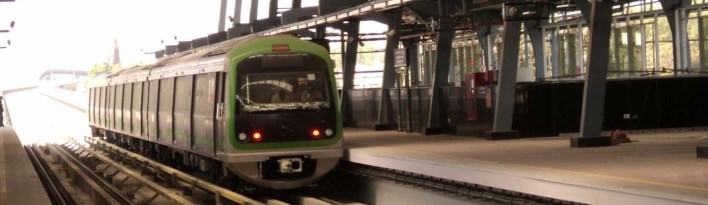
Bangalore Metro Purple Line
The Purple Line is 43.49 km and has 37 stations from Challaghatta to Whitefield. Most of the Purple Line is elevated, with thirty one elevated stations, one at-grade station and five underground stations.
Bangalore Metro Purple Line Stations And Other Info
Below are the details of the Bangalore Metro Purple Line stations and other information.
| Serial Number | Station Name - Purple Line | Type | Parking Availability |
|---|---|---|---|
| 1 | Whitefield (Kadugodi) | Elevated | Available |
| 2 | Hopefarm Channasandra | Elevated | Available |
| 3 | Kadugodi Tree Park | Elevated | Available |
| 4 | Pattanduru Agrahara | Elevated | Available |
| 5 | Sri Sathya Sai Hospital | Elevated | Available |
| 6 | Nallurhalli | Elevated | Available |
| 7 | Kundalahalli | Elevated | Available |
| 8 | Seetharampalya | Elevated | Available |
| 9 | Hoodi | Elevated | Available |
| 10 | Garudacharpalya | Elevated | Available |
| 11 | Singayyanapalya | Elevated | Available |
| 12 | Krishnarajapura (K.R.Pura) | Elevated | Available |
| 13 | Benniganahalli | Elevated | Available |
| 14 | Baiyappanahalli | At-grade | Available |
| 15 | Swami Vivekananda Road | Elevated | Available |
| 16 | Indiranagar | Elevated | Available |
| 17 | Halasuru | Elevated | Not Available |
| 18 | Trinity | Elevated | Not Available |
| 19 | MG Road | Elevated | Not Available |
| 20 | Cubbon Park | Underground | Not Available |
| 21 | Dr. BR. Ambedkar Station, Vidhana Soudha | Underground | Not Available |
| 22 | Sir M. Visveshwaraya Station, Central College | Underground | Not Available |
| 23 | Nadaprabhu Kempegowda station, Majestic | Underground | Not Available |
| 24 | City Railway station | Underground | Available |
| 25 | Magadi Road | Elevated | Available |
| 26 | Sri Balagangadharanatha Swamiji Station, Hosahalli | Elevated | Not Available |
| 27 | Vijayanagara | Elevated | Not Available |
| 28 | Attiguppe | Elevated | Not Available |
| 29 | Deepanjali Nagara | Elevated | Available |
| 30 | Mysore Road | Elevated | Available |
| 31 | Pantharapalya - Nayandahalli | Elevated | Available |
| 32 | Rajarajeshwari Nagar | Elevated | Available |
| 33 | Jnanabharathi | Elevated | Not Available |
| 34 | Pattanagere | Elevated | Available |
| 35 | Kengeri Bus Terminal | Elevated | Available |
| 36 | Kengeri | Elevated | Not Available |
| 37 | Challaghatta | Elevated | Not Available |
Bangalore Metro Purple Line timings and frequency
The Bangalore Metro Purple Line from Whitefield to Challaghatta operates from 5:00 AM to 11:00 PM with a frequency of 5-7 minutes. However, on Sundays, the trains run from 7:00 AM to 10:40 PM with a gap of 8 to 10 minutes.
Peak Hours
- Whitefield (Kadugodi) to Pattandur Agrahara: 10 minutes
- Pattandur Agrahara to Mysore Road: 5 minutes
- Majestic to MG Road: 3 minutes (only during peak hours in the morning)
- Mysore Road to Challaghatta: 10 minutes
Other times
In times other than the peak hours, it is about 8 – 10 minutes and during the early morning hours, it takes about 15 minutes.
Bangalore Metro Purple Line Travel Time And Fare
- Whitefield (Kadugodi) to Challaghatta: About 85 minutes
- Fare: Rs 57 to Rs 60
Bangalore Metro Green Line
Bangalore Metro Green Line is 30.5 km with 29 active stations, of which 26 are elevated, and 3 are underground stations. It connects Nagasandra in the northwest to the Silk Institute in the south. The line also connects Peenya and Yelahanka, the industrial centres in the north, with Majestic and the residential areas of South Bangalore, Basavangudi, Jayanagar and Banashankari.
Bangalore Metro Green Line timings and frequency
The Bangalore Metro Green Line from Nagasandra to Silk Institute operates from,
- Monday to Saturday: 5:00 AM to 10.35 PM
- Second and Fourth Saturday: 6 AM to 10.35 PM
- Sunday: 7 AM to 11 PM
The frequency is 15 minutes between 5 AM and 8 AM and 8 PM and 11 PM and 10 minutes between 8 AM and 8 PM.
Bangalore Metro Green Line Fare
Bangalore Green Line fare ranges from Rs 10 to Rs 60.
Bangalore Metro Green Line Travel Time
The total travel time from Nagasandra to Silk Institute is 70 minutes.
Bangalore Metro Green Line Stations And Other Info
Below are the details of the Bangalore Metro Green Line stations and other information.
| Serial No | Station Name - Green Line | Type | Parking Availability |
|---|---|---|---|
| Nagasandra | Elevated | Available | |
| Dasarahalli | Elevated | Available | |
| Jalahalli | Elevated | Available | |
| Peenya Industry | Elevated | Not Available | |
| Peenya | Elevated | Not Available | |
| Goraguntepalya | Elevated | Not Available | |
| Yeshwanthpur | Elevated | Available | |
| Sandal Soap Factory | Elevated | Available | |
| Mahalakshmi | Elevated | Not Available | |
| Rajaji Nagar | Elevated | Available | |
| Mahakavi Kuvempu Road | Elevated | Not Available | |
| Srirampura | Elevated | Not Available | |
| Sampige Road | Elevated | Available | |
| Nadaprabhu Kempegowda station, Majestic | Underground | Not Available | |
| Chickpete | Underground | Available | |
| Krishna Rajendra Market | Underground | Available | |
| National College | Underground | Available | |
| Lalbagh Botanical Garden | Elevated | Not Available | |
| South End Circle | Elevated | Not Available | |
| Jayanagar | Elevated | Available | |
| Rashtreeya Vidyalaya Road | Elevated | Not Available | |
| Banashankari | Elevated | Not Available | |
| Jaya Prakash Nagar | Elevated | Not Available | |
| Yelachenahalli | Elevated | Available | |
| Konankunte Cross | Elevated | Not Available | |
| Doddakallasandra | Elevated | Not Available | |
| Vajarahalli | Elevated | Not Available | |
| Talaghattapura | Elevated | Not Available | |
| Silk Institute | Elevated | Not Available |
Land Acquired From The Railway Board
The Railway Board has approved transferring 3500 sqm of land near KR Puram station to the Bangalore Metro Rail Corporation Limited (BMRCL). This land will be used to widen the road connecting Tin Factory-KR Puram and Marathahalli-Whitefield. In exchange, the Railway Board will be given an equal-sized land portion elsewhere. The land has been identified and is in possession of the BDA.
To widen the road, many buildings flanking the existing road between Outer Ring Road (ORR) flyover and KR Puram Railway station will be partially or fully demolished.
Other Land Acquisitions
Additional land has also been acquired from private parties for the road widening as well as the construction of a Diaphragm Wall on the Benniganahalli lake bund. This is required for road work as well as to lay the Metro pillars. The Diaphragm Wall will be 14m long from the top of the lake bund to below the lake. This is being constructed to keep water from flowing over the structure.
Green Signal For Elevated Line Over Salem Railway Line
The Bengaluru Railway Division has also given the BMRCL permission to construct an elevated Metro line over the existing Salem railway line near Benniganahalli. The Metro line will stand 65m over the railway line. Thus, it meets the 8m clearance required for trains on these railway lines. This is the last piece of civil work remaining on this line.
Bangalore Metro Ticket Options – Smart Solution for a Comfortable Journey
The Bangalore Metro provides the option of Smart Tokens and Smart Cards for travel. There are different fare structures for each of them.
Smart Tokens
These tokens are available for a minimum cost of Rs. 10. Each token is valid for a single journey. Tokens are to be touched on the pad near the entry gates at the Main Entry and to be dropped after use at the slots provided at the Exit Stations.
Contactless Smart Cards
These cards can be purchased for multiple journeys. The minimum cost of the card is Rs. 50 but the travel value is different. These cards offer discounts of 15% to 23% as compared to the tokens.
Varshik and Sanchar Cards
The “Varshik” is a refillable card that stores credit of up to Rs. 1,500. It is swiped at the Main entry and exit points of the stations, and the fare is deducted. The minimum fare is Rs. 8.50.
The “Sanchar” is a multi-trip card that can be used for up to 100 trips between two fixed points. It is designed for commuters who always travel on the same route, like office-goers, college students, etc. Fares are cheaper than those offered on the Varshik card. The minimum fare is Rs. 7.65 if 100 trips are purchased in advance.
Group Tickets
These are paper tickets and they can be issued to a group of ten members travelling between the same stations.
Metro-Bus Ticket (MBT) Day Pass
It is an integrated metro and bus travel ticket that offers unlimited journeys for the whole day for Smart Card holders. A “Saral” ticket costs Rs. 110 and is valid for travel on air-conditioned buses (but not on Airport buses). A “Saraag” ticket costs Rs. 70 and is only valid for travel on the Metro rails and non-air-conditioned buses.
Combo Cards
It is an SBI Debit-cum-Transit card issued by SBI. It has a contactless chip and a magnetic stripe that can be used for ticketing and banking applications respectively. The card offers the convenience of loading value or trips, as per the commuter’s convenience. It is a multiple-use card that provides a discount of 15% to 21% over the rates applicable for tokens.
Multiple Tickets in a Card
This smart card offers the convenience of holding any or all three types of tickets i.e., Varshik, Sanchar and MBT. Varshik ticket comes as default with every card.
Metro Tickets Outlets – Easy Availability
Bangalore Metro offers several ticket sale outlets. Commuters can buy tickets from the ticket counters at stations and ticket vending machines or TVM (to be installed shortly).
MBT Day passes can be purchased at select bus stations and in buses operating in vicinity of Reach 1. Combo Cards can be obtained from the SBI branches where the commuters maintain their bank accounts.
Topping-up of smart cards (containing Varshik or Sanchar tickets) can be done at Metro stations, ticket vending machines, Airtel retail outlets and BMRCL website. Topping up of Varshik ticket on Metro and Combo card can be done at SBI ATM or through SBI net banking, SBI mobile banking or by auto top-up done through standing instructions to SBI.
Bangalore Metro – One mobile QR ticketing system for multiple people
Bangalore Metro Rail Corporation (BMCRL) will soon facilitate group travel to benefit families using one mobile QR ticketing system. Currently a QR ticket allows only one passenger to pass through. However, owing to public demand, Bangalore metro will soon enable multiple people to travel with the same QR code to be tapped at the automatic fare collection (AFC) gates. For example, if a person needs to buy three tickets through the app, the system will generate a QR code, which has to be tapped at the AFC gates three times separately for each person to enter. BMCRL is at present working on bringing about this system along with the app provider to enable group travel.
The Metro Ride app – Improving Last Mile Connectivity
Along with extending the metro route, efforts are also being made to improve the commute to and from metro stations. The Metro Ride app offers a quick and economical way for commuters to get from their homes to the metro station and from the metro station to their end destination.
The service connects 66 metro stations on the Green Line and Purple Line in Bangalore. To book a ride to the metro station, you will need to sue the app on your phone. This app is free for Android phones and iPhones. On the app, you can use your location according to GPS settings or enter a landmark to select a pick up point. You can also specify the number of seats required. The app will show you’re the shortest route and ticket fee for the same. Payments can be made online.
This pick and drop service makes using the metro much more convenient as you no longer have to wait for an auto or cab. Neither do you need to take your car to the metro station and circle the parking lot looking for a space to park your car.
You can download the app here:
- For Android Phones: Download Now
- For iPhones: Download Now
Also See:
- Bangalore Metro – quick summary
- Bangalore Metro Stations & Fares
- Metro Rail Link to BIA
- Monorail
- Bangalore Metro Guidelines For Unlock 4 – The Dos And Don’ts