The famous Mallikarjuna Temple lies in Basaralu. In the Mandya district of Karnataka, lies a small town named Basaralu. It lies at a distance of 65 kms from the city of Mysore which has historical and architectural importance in the State of Karnataka.
Basaralu is famous for the finest architecture that lies in the two temples located there. These temples reflect the ancient Hoysala architecture. There are two temples in the complex- the Chandikeshwara temple and the famous Mallikarjuna Temple, both dedicated to Lord Shiva.
History of Mallikarjuna Temple, Basaralu
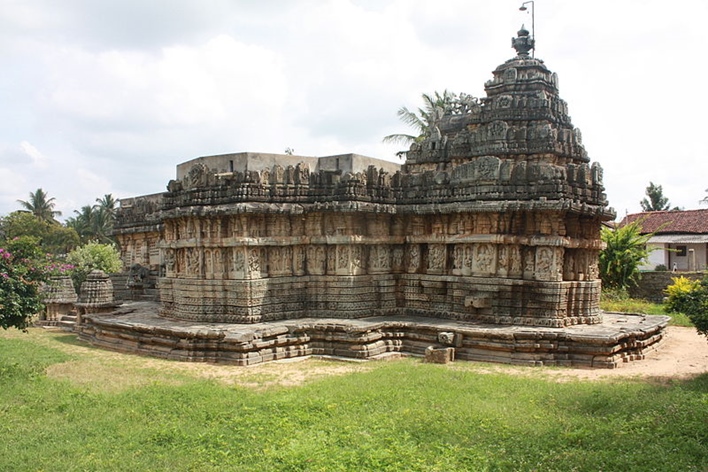
The Mallikarjuna Temple at Basaralu was built around the year 1234 A.D. the Archaeological Survey of India has safeguarded the temple as a memorial holding national Importance. The village is famous for the temple located here, it has a rich architectural history and has old sculptures and hero stones within the temple.
Architecture of Mallikarjuna Temple, Basaralu
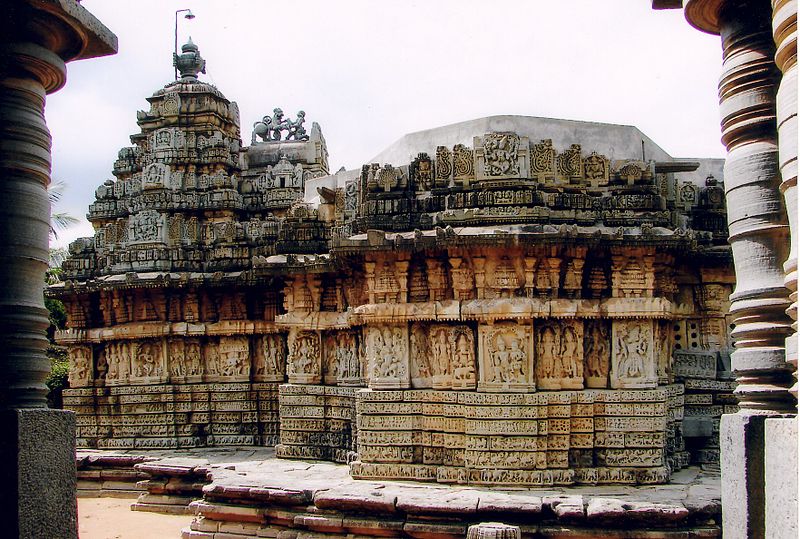
The Mallikarjuna Temple, Basaralu is well known for its ancient architecture. It has famous sculptures that make the Hoysala architecture a work of art. The temple is a three shrined plan. All the three shrines here are internally allied by a mantapa. Only the central shrine has a tower on the top which makes it easily visible from the outside. The adjacent shrines do not have a tower and are internally linked to the hall, although it is not clearly visible from the outside.
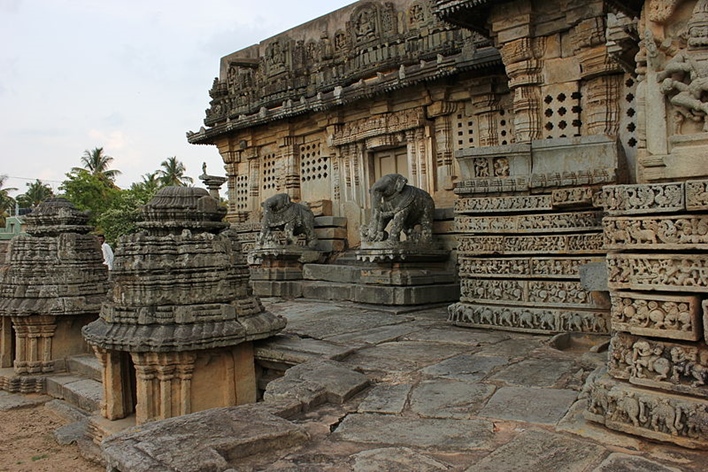
Hoysala temples use a platform called jagati, on which this temple stands. This platform provides a path to the devotees to walk and also adds visual appeal. The top of the temple has an emblem of a Sala killing a lion which is a part of the Hoysala architecture. At the bottom of the temple lies six pattikas, which show war elephants, horse riders, scenes from Ramayana, Mahabharata and Bhagvata and swans at the last.
Chandikeshwara temple at Basaralu
Apart from the Mallikarjuna Temple, there is the Chandikeshwara temple that is of prominent importance in the Hoysala architecture. There is a Bhairavi sculpture lying at the center of the temple. One of the most notable sculptures in the temple is the sculpture of the sixteen headed Shiva who is shown dancing on the head of a demon.
Apart from the sculpture of Shiva, there are twenty-two dancing images armed Saraswati and Durga, the image of Arjuna, Draupadi, Ravana and many more. There is a 20 foot pillar right across the temple. The Ardha Mandap has a ceiling which is intricately carved and has carvings of the Agni, Yama, Kubera, Vayu, Varuna, Ishana, Indira and Nirurti.


When to visit Mallikarjuna Temple
The best time to visit Basaralu is from October to February.
How to Reach Mallikarjuna Temple
By Air
The nearest airport to Basaralu is in Bangalore that lies at a distance of 130 kms.
By Rail
The nearest railhead lies in Bangalore and Mysore that lie at a distance of 130 kms and 65 kms respectively.
By Road
Basaralu has a well-connected road network. It can be reached from Bangalore and Mysore. There are various buses plying towards Mysore and pass through Mandya. You will be required to take a right from the Mandya Chikki and travel an additional eight kms before turning left and driving another 25 kms to reach the Basaralu village.