District: Bellary
Village: Hampi
Temple Deity: Rama, Laxmana and Sita
Kodanda Rama Temple is situated in Hampi in the Bellary district of Karnataka. The temple is one of the most famous monuments of Hampi, a UNESCO World Heritage Site. Situated in the eastern part of the village, the Kodanda Rama temple stands more as a significant religious structure than as an architectural beauty.
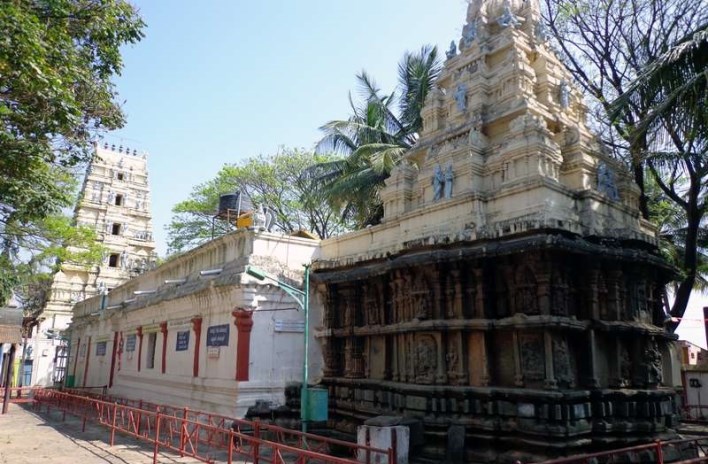
Kodanda Rama Temple – Overview
As the name indicates, the Kodanda Rama temple is dedicated to the Hindu deity Lord Rama. The inner sanctum of the temple has huge idols of Lord Rama, his brother Laxmana and his wife Sita. The statues of the idols were carved out from a single natural boulder. The temple is situated near the river Tungabhadra.
The holy bathing ghat of Chakrathirtha is situated in front of the temple. It is considered to be one of the most auspicious spots for pilgrimage by the Hindus.
The historic temple is believed to mark the spot where Rama had crowned the monkey king Sugriva. The belief gets credence from the fact that the temple has an idol of Sugriva bowing to Lord Rama. This is a unique feature as temples dedicated to Lord Rama generally have an idol of Hanuman bowing to the Hindu deity, but not Sugriva.
The holy bathing ghat and the temple have been attracting visitors since ancient times.
Kodanda Rama Temple – Architecture
The temple stands over a large area and has been carved in a beautiful manner. The pillars of the temple are decorated with various sculptures. The inner sanctum of the temple has a rectangular shape. Traces of Hoysala style and Dravidian style of architecture can be seen in the temple construction.
Kodanda Rama Temple – Myths and Legends
The temple is considered to be one of the oldest places of worship in Karnataka. It has several legends and mythological beliefs associated with it. According to the local myths, the temple stands on the spot where Vali was killed by Lord Rama before he went on to crown Sugriva as the king of Kishkhinda.
It is also believed that Sugriva had carved the idols of Rama, Laxmana and Sita from the natural boulder on the hillside and built the temple for the worship of the deities at this spot. As such, it is believed that the temple has been standing on this place since the time of Ramayana.
How to reach
Hampi is situated at a distance of 353 km from Bangalore. As the place is a renowned tourist destination, it is well connected by several means of transport and can be easily reached from the other parts of the state and beyond.
By Air
The nearest domestic airport to reach the village is situated at Hubli at a distance of 143 km. The nearest international airport is located in Bangalore.
By Rail
Hampi has the nearest railway junction located at Hospet at a distance of 13 km. Several trains are available from the Hospet Junction to various other towns and cities of the country. It is easy to reach Hampi from Hospet. Auto rickshaws are available from Hospet to Hampi. There are also several government buses that ply between Hospet and Hampi.
By Road
Hampi is well connected by road network. KSRTC Bus services are available from all over the state to Hospet and Bellary at frequent intervals. Taxis, cars and vehicles-on-hire are also available for a trip to Hampi from Bangalore, Mysore and other areas of the state.
Also See: